
I spent 14 years meaning to write this book. Here's what finally made me do it (and what it's actually about).
My first "Yes And" book came out in 2012.
I always planned to write a follow-up. A deeper one. One with more tactical meat on the bones, not just mindset and inspiration. Something a leader could keep on their desk and actually use.
That was 14 years ago.
Life happens. I got distracted. Had a baby in 2023. Did the thing where I told myself I'd "get to it soon" for about a decade. Classic.
I finally started brainstorming in earnest around 2022 (index cards, a pile of books, no real plan) and then jumped in fully in early 2025. I assumed I'd crank it out fast, have it done by summer, and launch in the fall.
It is now March. The book comes out in April. So that tells you how that went.
(This week's podcast episode covers some of the same ground. If you'd rather listen than read, you can find it here. But this post isn't a transcript; I've gone deeper on a few things and structured it differently, so if you have 10 minutes to read, there's material here that isn't in the episode.)
But it's done. And I'm genuinely proud of it in a way I haven't felt about my work in a while. Not because I finished it, but because I kept editing it past the point where I wanted to be done. I'm an improviser. I believe in speed. I believe in shipping. And yet I kept going back in, because "a little better" actually mattered this time. The book is called Say “Yes, And!” to Change. And I want to tell you what it's actually about, because I think most people will assume they already know.
They probably don't.
The Problem Most People Think I Solve is Not the Problem I Actually Solve
For years, I thought my job as a speaker and trainer was to take people who were resisting change and get them to accept it. That's the obvious market. That's what most change management people talk about. Resistance. Hostility. People dragging their feet.
But here's what I noticed over time: Resistance is actually the easier problem.
When someone is resistant, you can see it. They push back in meetings. They voice objections. They make their disagreement known. That's annoying, but you can address it. You know it's there.
Apathy is different.
Apathy looks like compliance. People sit in meetings, nod along, say "sure," and go back to their desks. They're doing their work. They're not causing problems. But they're checked out. They're not innovating. They're not bringing their best. They're quietly burning out or quietly looking for the exit. And you don't see it coming until someone leaves or a project quietly underperforms.
Think of a bell curve. The resisters are at one end. The genuinely excited are at the other. The middle 80%? They're not hostile and they're not energized. They're just... there. That is the real problem. And in my experience, it's the one nobody is actually solving for.
The subtitle of the book is: How to Harness Change, Unlock Brilliance, and Transform Apathy into Excitement.
That last part is the whole point.
The Framework: YES AND as an Acronym
The heart of the book is a six-part framework built around the letters Y-E-S-A-N-D. Each letter is its own concept. They're not sequential steps; they’re more like six levers you can pull in any order depending on what the moment calls for. Here's a quick version of each.
Y: Yield to What Is
Not the same as giving up. Think about what "yield" actually means when you're driving. You don't stop. You don't give up. You pause, read the situation, and when there's an opening, you move. “Yielding to What Is” means accepting the current reality instead of fighting it or pining for the way things were. It's the starting point for everything else. You can't build toward what can be if you're still arguing about what was.
There's a second piece here I love: setting what I call an impossible goal. Not a SMART goal. An impossible one. The kind where your first reaction is "yeah, but I don't know how I'd actually do that." That discomfort is the point. An impossible goal forces creativity, forces new thinking, and (this is the part people miss) forces engagement. You cannot be apathetic about something that genuinely excites and scares you.
E: Explore and Express Your Core
Everyone has a core. Strengths, passions, the things you're wired for. The problem is that most people lose touch with it. We become practical. We do what we need to do to get through the day. We mask ourselves to be more palatable. And over time, we forget what we're actually good at and what lights us up.
This is one of the biggest sources of apathy I see. Not that people don't care about their work in the abstract. It's that they're not doing work that feels like them. When you find small ways to bring your actual self into what you're doing, your output changes. Your engagement changes. This is also how people access what I'd call the flow state: that condition where time passes differently and you do your best work without forcing it.
S: Start Small and Take Small Steps
This one I've been talking about for over 20 years, since my very first presentation.
Improv comedians know this: You get in trouble the moment you start planning ahead. The moment you're playing a scene while also engineering where you want it to end up, everything in the middle suffers. The best improv comes from full focus on the one next move.
In the book I talk about three versions of the next step: The most important next step (when you're energized and clear), the most doable next step (when you're overwhelmed and just need to move), and the most fun next step (when you're in that ennui zone and nothing is pulling you forward). The right next step depends on where you actually are, not where you think you should be.
This connects to what I call AAA: Act, Analyze, Adjust. Take a small step. See what happens. Adjust. Repeat. Not linear progress, jagged progress. Which is actually better, because you're improving the process as you go instead of discovering at the end that your original plan had a fatal flaw.
(I have a painful story in the book about a daily blog I ran for three years that never booked a single piece of business. I kept going because I never built in any triggers to stop and ask whether it was working. Don't be me.)
A: Access and Apply Your Creative Genius
Everyone is creative. I know that sounds like a bumper sticker, but I mean it in a specific way: we are all born with a natural creative capacity, and we spend our entire lives building filters that suppress it. We're taught to think before we speak. To edit before we share. Those filters are useful. They also cut off the flow of ideas before they have a chance to develop into anything interesting.
The chapter on this is probably my favorite in the book. It's about how to deliberately access that creative capacity: specific exercises, tools, and approaches. And here's the practical payoff: Regularly exercising your creativity is one of the primary ways people shift out of apathy. When you're in a creative flow, you're engaged. Time moves differently. That's not an accident, and it's not just a nice feeling. It's a state you can cultivate.
N: Notice and Nurture Emotion
This is the one most leaders skip because they've been told emotions don't belong at work.
Here's the thing: The people who say that are usually saying it from a highly emotional state themselves. The feelings don't go away because you tell people to ignore them. They go underground, and they come out sideways in your decisions, your communication, and eventually your team's behavior.
Noticing your emotions means asking, in the moment: What am I actually feeling, and is this the most useful emotion for what I'm trying to do right now? If I'm about to have a hard conversation while I'm angry, I'm probably going to make it worse. If I'm going into a presentation while I'm anxious, that anxiety is information worth paying attention to.
And as a leader, this matters even more, because the emotions you project ripple out. Your team feels what you're feeling whether you intend them to or not. And consider: both apathy and excitement are emotions. If your goal is to move people from one to the other, you have to actually work with emotion, not around it.
This, honestly, is the concept in the book that I think is most underrated in the improv world too, not just the business world.
D: Dig Deeper
The "And" in "Yes, And."
"Yes, but" keeps things at the surface. You cut people off, you redirect, you move on. "Yes, And" goes further. Tell me more. What do you mean by that? What's underneath what you just said?
When someone comes to you with a complaint or a problem, the surface version of that complaint is rarely the whole story. The real concern, the actual objection, the emotion underneath; those usually require a few more questions to get to.
The technique for this is almost embarrassingly simple: Ask questions and actually listen to the answers. I have interviewed so many leaders on my podcast, and when I ask them the one thing that made the biggest difference in how they lead, more often than not they describe some version of this. Ask. Listen. Do something with what you hear. It sounds obvious. Most people don't actually do it.
In improv, we talk about advancing versus expanding. You don't always have to jump to the next idea. Sometimes you dig into the one you're already in, and that's where the richness comes from. That's often where the next best idea lives too.
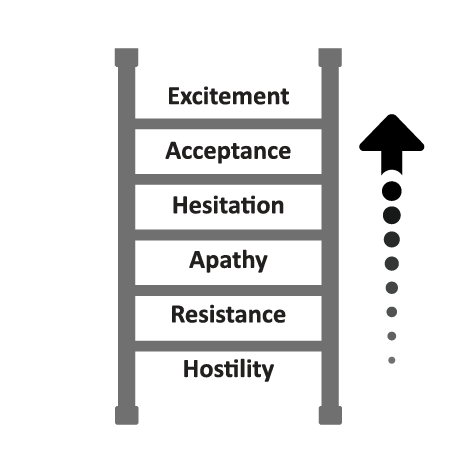
There's also a “Change Response Ladder” in the Book.
It has six stages: hostility, resistance, apathy, hesitation, acceptance, excitement. The point isn't to get your team from the bottom to the top overnight. The point is to understand where people actually are and to just move them one rung. Someone who goes from apathetic to hesitant has made real progress, even if they're not excited yet.
That reframe alone has changed how some of the leaders I work with think about what "success" looks like during a difficult transition.
The book is out end of April. If you are a leader who has ever looked out at a room of people going through a change and thought "they're fine, but they're not excited," this is for you. That's the problem the book is built to solve.
Want a Free Copy of the Book?
If you want to read it before it launches and leave an honest Amazon review, I'm looking for ARC (advanced reader copy) readers. You get a free digital copy. All I ask is for an honest review when it goes live. Click here to sign up now.
IMPORTANT! ARCs are going out on March 23rd, so sign up now if you want to join the launch team!
A Quick Note on the 14 Years it Took to Write This:
I have mentioned before that I'm stubborn. That's accurate. I've stayed with things way too long when I should have adjusted, and I've made some genuinely bad decisions out of impatience and desperation when patience would have served me better. The blog story in the book is one example. There are others.
What I can say is that the extra time did one useful thing: it forced me to test everything in this framework with actual groups, in actual programs, before I put it in a book. Nothing in here is theoretical. It's all stuff I've worked through with leaders and teams, and it's now organized in a way I couldn't have organized it 14 years ago.
Whether that was worth the wait is not really for me to say. But I'm glad I finally sat down and wrote it.