

One of the most famous lines in Game of Thrones comes from Littlefinger:
“Chaos isn’t a pit. Chaos is a ladder.”
I love the show. (Well… most of it. IYKYK…) and think about it often. My social media algorithms like to pop clips up into my feed, and this quote came up recently.
And that made me realize something about change…
Most people experience change as a pit. Something they fall into. Something that happens to them. When a new system rolls out, a reorganization happens, or leadership announces a big shift, the instinctive reaction is often frustration, anxiety, or resistance.
But in reality, change works much more like a ladder.
The same event can produce wildly different reactions depending on how people engage with it. Some people fight it every step of the way. Others quietly comply while wishing things would go back to the way they were. Some approach it cautiously. And a few see the opportunity hidden inside the disruption and lean into it.
Over years of working with organizations navigating change, I started noticing a pattern in these reactions. People weren’t just randomly responding differently; they were responding from distinct levels of engagement. That observation led me to develop something I call the Change Response Ladder.
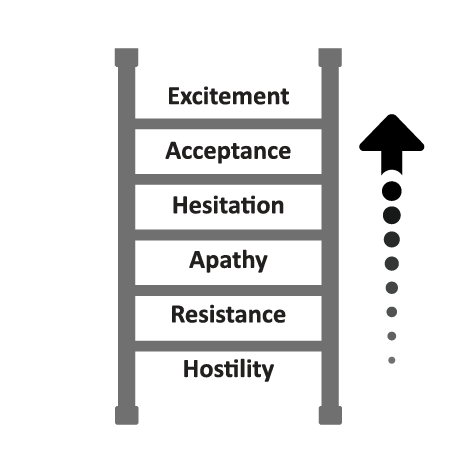
The ladder illustrates six common responses people have when change occurs. At the bottom are responses that drain energy and stall progress. As you move upward, the responses become increasingly constructive, creative, and empowering. The key insight is that most people don’t stay in one place permanently. They move up and down the ladder depending on the situation, the support around them, and how safe they feel participating in the change.
Understanding where someone is on that ladder can completely change how you approach the situation.
Below is an excerpt from my upcoming book Say “Yes, And!” to Change, that explains this.
Chapter 3 - The Change Response Ladder
Because once you know where you stand, you can finally move forward with intention...
Most people think they respond to change in one consistent way: “I’m flexible,” or “I hate change,” or “I get there eventually.” But your response actually shifts depending on the situation: the stakes, the pressure, your confidence, and how supported you feel. You’re not one fixed type. You move along a spectrum of responses, ranging from deeply unhelpful to incredibly empowering. And understanding where you are on that spectrum is the first step toward moving yourself and others in the right direction.
This is the Change Response Ladder.
Here are the six levels, from bottom to top:
Change Hostility: Active pushback. Sabotage. Public frustration. “This is stupid, and I’m not doing it.” You’ll see this person vocally push back in meetings, question every decision, or even undermine the change behind closed doors. Hostility drains leaders and team members alike.
Change Resistance: Not hostile, but definitely not helpful. “I’ll do it if I have to, but I won’t like it.” This person drags their feet, does the bare minimum, and sighs heavily every time the change is mentioned. Resistance creates friction. Not enough to stop progress, but enough to make it painful.
Change Apathy: Numbness. Indifference. Disengagement. “Whatever, I’ll do my job. Just don’t ask me to care.” This person shows up, nods along, and contributes nothing. They’re present but checked out. No alarms go off, no red flags wave, but creativity flatlines, initiative disappears, and people stop offering their brilliance.
Change Hesitation: Curious but cautious. “Okay... maybe. Let’s see how this goes.” This person asks thoughtful questions, tests the waters cautiously, and waits for proof before committing.
Change Acceptance: Willing participation. “I’ll make the best of it. Let’s do this.” This person participates willingly, follows through on tasks, and approaches the change with a “can-do” attitude. This is where many organizations stop (and think they’re succeeding). Acceptance is good... but it’s not transformation.
Change Excitement: Seeing change as a launchpad rather than a threat. “This could be awesome. Let’s go!” This person volunteers for pilots, brainstorms improvements, and energizes others with their optimism. This is where potential ignites. People contribute ideas, take ownership, collaborate creatively, and move the organization forward with energy instead of obligation.
(If you're curious about the rest of the framework, I'm currently assembling a launch team for the book and sharing free digital advanced reader copies before publication. More on that at the end of this article.)
One of the most important insights from the ladder is that many organizations mistake acceptance for success.
When employees stop pushing back and start complying, leaders assume the change has taken hold. But acceptance is not the top of the ladder.
Acceptance means people will do what is required. Excitement means people will contribute their ideas, creativity, and ownership to the change. That’s where real momentum begins. When people move from compliance to contribution, the change stops feeling like something imposed from above and starts becoming something the team actively shapes.
The good news is that people don’t need to leap from hostility to excitement overnight. The real power of the ladder is that it shows a path upward. When someone moves even one rung higher, the entire dynamic around the change can shift.
If you’re navigating change right now—whether you’re leading it or experiencing it—here are three actions you can take immediately.
1. Identify Your Current Rung
The first step is honest awareness. Ask yourself, “Where am I on the ladder right now?” Are you resisting the change? Feeling apathetic about it? Hesitant but curious? Simply naming your current position helps you regain a sense of agency. You’re no longer just reacting to change—you’re observing your response to it.
2. Move One Step Up
You don’t have to jump to excitement overnight. Instead, focus on the next rung. If you’re in resistance, the next step might simply be asking a curious question. If you’re apathetic, the next step might be identifying one small way the change could benefit your team or your work. Small upward movements often create surprising momentum.
3. Help Someone Else Climb
If you’re a leader, your role isn’t to drag people up the ladder. Your role is to create conditions where climbing feels possible. That might mean listening to someone’s concerns so hostility softens into resistance, clarifying the purpose behind the change so hesitation becomes acceptance, or inviting people to experiment so acceptance turns into excitement.
When people move upward together, the energy of the entire organization shifts.
Change will always be part of organizational life. Strategies evolve, markets shift, technology advances, and teams grow in new directions. Eliminating change is impossible.
But how we respond to it is something we can influence.
So the next time change shows up in your work or your organization, pause and ask yourself a different question:
Are you stuck in a pit…
…or are you standing at the bottom of a ladder?
Your Turn
Which rung are YOU on right now with a change in your life or work? And if you're a leader, which rung do you see most of your team on?
Hostility? Resistance? Apathy? Hesitation? Acceptance? Excitement?
Drop it in the comments or get in touch via email, I’d love to hear what you’re seeing.
Now, about that launch team I'm building for my upcoming book, Say “Yes, And!” to Change... I'm sharing free digital advanced reader copies with people who want an early look and are willing to leave an honest review when the book launches.
If you'd like to join the launch team, just drop me a line like “Yes Avish, I would like to join the Launch Team and get a free advanced digital copy of your book” and I’ll send you the details.