
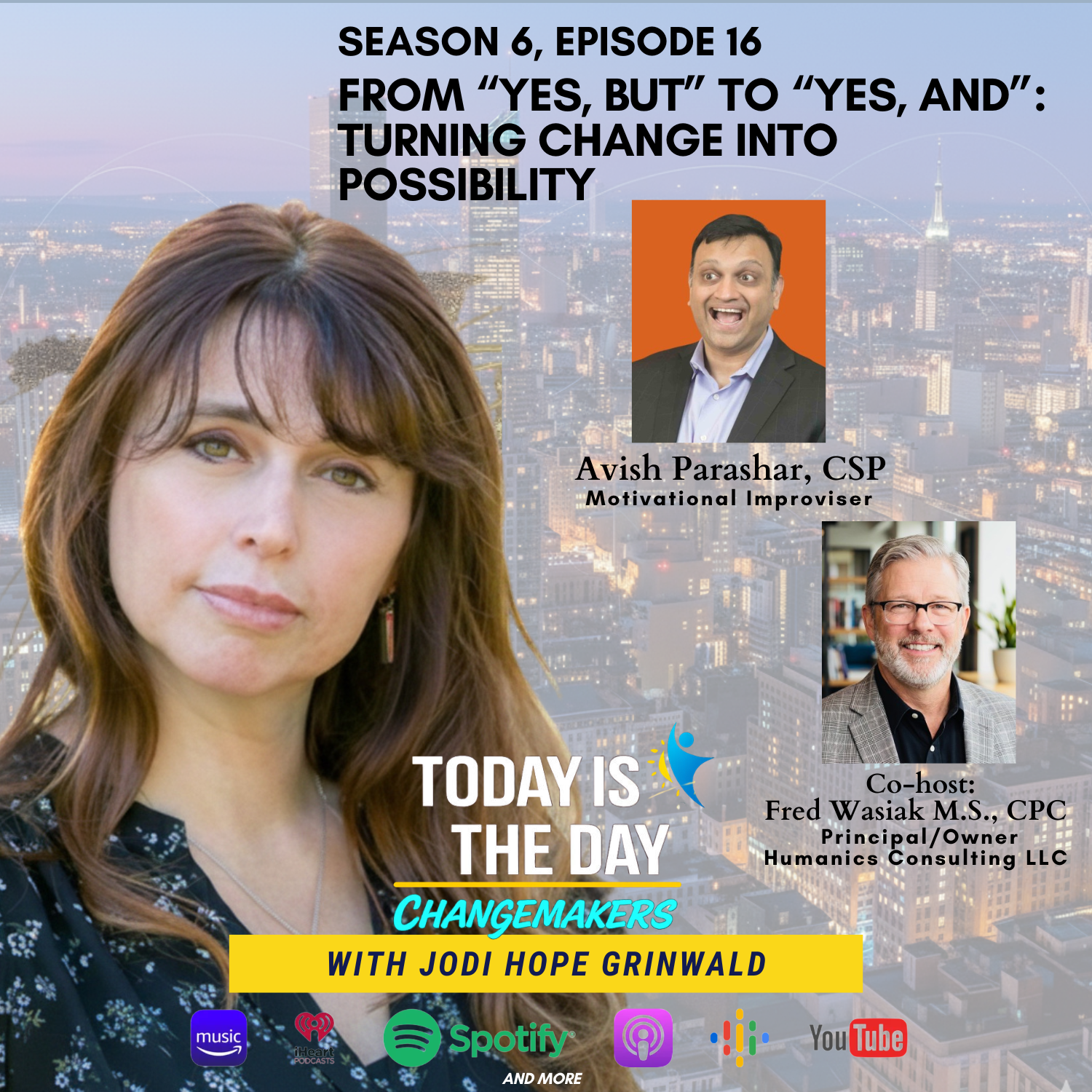
This week's episode of Say Yes, And is a little different - because I'm giving up the host's chair.
Recently, I joined Jodi Grinwald on her Today is the Day Changemakers podcast, along with guest co-host Fred Wasiak of Humanics Consulting. Jodi was kind enough to let me share that conversation here, which gives me the opportunity to introduce you to her work while also letting you hear a side of me that doesn't always come out when I'm the one asking the questions.
And we covered a lot of ground.
We talk about my journey from a quiet, introverted kid to engineer, improv comedian, and professional speaker; why the principles of improv apply far beyond comedy; and how switching from “Yes, but” to “Yes, and” can change the way we approach leadership, creativity, uncertainty, and change.
But we also get more personal.
I talk about my own struggles with approval seeking, distraction, social media, and the strange power one negative comment can have even when it's surrounded by a hundred positive ones. We explore why I've been intentionally trying to spend more time feeling bored, awkward, rejected, and frustrated—and why those uncomfortable states may actually be essential to creativity, growth, connection, and meaningful work.
We also dig into why leaders often focus too much attention on vocal resistors while overlooking the much larger group of people who have simply become disengaged, why creativity often appears only after we start creating, and why one of the most important leadership skills may be the willingness to let go of your own idea and genuinely explore someone else's.
If you've ever found yourself procrastinating because you're uncomfortable, resisting a change because you don't know exactly where it will lead, or saying “Yes, but” to an idea before you've really explored it, there's something in this conversation for you.
And be sure to check out Jodi and Today is the Day Changemakers. I'll be turning the tables again when Jodi joins me as a guest on Say Yes, And in a future episode.
Key Takeaways
Get comfortable with discomfort. Boredom, awkwardness, rejection, and frustration aren't necessarily signals to stop. They can be signs that you're doing something that requires growth.
“Yes, but” is a brake; “Yes, and” is an accelerator. Changing your default response can open possibilities in leadership, communication, innovation, and change.
Boredom creates room for creativity. Constant stimulation makes it easy to escape the uncomfortable space where new ideas often emerge.
Creation begets creation. Sometimes you won't think your way into the next great idea—you have to start creating before the ideas arrive.
Don't wait until you have the entire path figured out. In uncertain situations, take a small step, learn from what happens, and adjust.
Engage the disengaged. Leaders can spend enormous energy trying to convince their loudest resistors while overlooking the quieter people who could potentially be re-engaged.
Let go and get curious. Strong leadership doesn't mean having every answer. Sometimes it means temporarily setting aside your own idea long enough to genuinely explore someone else's.
Say “Yes, And” to yourself first. Before you can create a more collaborative, adaptable culture around you, pay attention to all the ways you may be shutting down your own possibilities.
Relevant Links
Avish Parashar: AvishParashar.com
Say “Yes, And!” to Change: YesAndToChange.com
Jodi Grinwald / Today is the Day: TodayIsTheDayLiveIt.com
Today is the Day Changemakers Podcast: https://todayisthedayliveit.com/podcast
Humanics Consulting / Fred Wasiak: https://humanicsconsulting.com/index.php/fred-wasiak/
Unedited Transcript
Jodi Hope Grinwald
Take a moment and think about the amount of times you say "yes, but" instead of "yes, and." What if the key to navigating change isn't having all the answers, but learning how to speak to ourselves in a totally different way? On this episode of the Today's The Day Changemakers podcast, motivational keynote speaker and author Avish Parashar joins me and my guest co-host, Fred Wasiak, principal and owner of Humanics Consulting, and we explore how the "yes, and" mindset can help turn resistance and apathy into engagement, creativity, and forward momentum.
Jodi Hope Grinwald
We also get honest about imposter syndrome. How many times have you heard about imposter syndrome? Do you experience it? Many times. The most forward-facing people do, but don't like to share that. And why does one negative comment outweigh hundreds of positive ones that we may hear throughout our day? Think about that as well. How might your life or leadership change if you stop resisting the unexpected and learn to work with it? That's what we're going to talk about today: mindset shifting.
Jodi Hope Grinwald
Before we begin, purchase your copy of Today is the Day Live It, Edge of Comfort to Center of Impact on Amazon or online—Bards & Noble, Target, Walmart, and many other online retailers—and inside you will find myself and 30 other changemakers who shared the decisions and defining moments that helped us move beyond our comfort zones and create truly meaningful impact, unexpectedly.
Jodi Hope Grinwald
And if you're considering a career change, as I have many times, or your organization needs leadership development, team development, sales training, or nonprofit leadership and development support, let's connect. As I mentioned, I did change my career, and it has changed my life, and now I really want, as a certified professional coach and leadership and connection strategist, to help others do the same. I have more than 20 years of experience leading and developing teams, and I really know what it takes. At least I know what it took for me, and I'm here to support what it may take for you as you are leading your team, as you are part of a team, if you are looking to become an entrepreneur.
Jodi Hope Grinwald
All of these things I've experienced firsthand, and now I want to be able to share my knowledge and help people develop in the direction they want to grow and go to. Not only help you meet your goals today, because I will tell you one thing along my journey: my goals changed as I uncovered what they truly were, because many of them were hidden. So schedule a complimentary consultation with me. You can email me—Jodi, J-O-D-I—at todaysethedayliveit.com. Today is the day. Live it dot com. And together we can work to make sure that you get to where you want to be as you learn, grow, and thrive. Follow Today's The Day Live It on Facebook and Instagram. And now, let's meet today's changemaker.
Jodi Hope Grunewald
Hello everyone, and welcome to another episode of the Today's The Day Changemakers podcast. I'm your host, Jodi Hope Grunewald, and as I say every single episode, I interview the changemakers, the inspirers, and those who are disrupting the status quo in the best way possible. And this episode, yet again, we're on 8 now, Fred. Is that what it is?
Fred Wasiak
Yes. Working toward my cap.
Jodi Hope Grunewald
He is. He's working towards his hat. So, Fred Wasiak, who is the founder and owner and leader and every hat he wears for Humanics Consulting, and let's not forget Outdoors with Papa as well.
Fred Wasiak
Thank you. It's wonderful to be here again, and what an honor. I can't wait to dive into this one with Avish. So it's—thank you, Jodi, for inviting me to this great podcast that's coming our way right now.
Jodi Hope Grunewald
Well, actually, I have to thank you, because whenever Fred recommends somebody to be on the podcast—and he does this a lot, and I love it so much because I get to meet incredible people through Fred—he then gets to be a podcast host. So as you can see, I think we're on 8, so that's been 8 connections that he's been a part of, but there's so many others outside of these 8.
Jodi Hope Grunewald
After 5, he got the jacket, the Today's The Day Changemaker jacket, Avish. Now he's waiting for 10 to get the Today's The Day Changemaker hat. And just so everybody knows, I don't even have a changemaker jacket yet. So this is—he's got the one and only.
Jodi Hope Grunewald
So I want to introduce Avish Parashar. He is our guest today. Otherwise, I could talk about Fred and I and all of our shenanigans throughout the last couple of years. But Avish, it's wonderful to meet you.
Avish Parashar
It is great to be on with you and Fred. Good to see you again, and I am looking forward to it.
Jodi Hope Grunewald
Well, thank you. And I'm just going to let everybody know you are a motivational keynote speaker. You help leaders turn the hidden enemy of change, apathy, into engagement, creativity, and forward momentum through the "yes, and" mindset. You're author of Say Yes, And To Change.
Jodi Hope Grunewald
And I just—I love it. I have to be honest, I'm very upfront. Fred knows this I'm blunt. I didn't get to finish your entire book, but I did get to highlight a few things.
Jodi Hope Grunewald
So when we get to the book part, I do have some things I wanted to share with you. But I can't wait to get into our conversation, Avish. So welcome again.
Avish Parashar
Thank you. I can't wait to chat about it.
Jodi Hope Grunewald
So before we get there, as Fred knows this, I always go backwards in people's lives, right? Because it's—we don't—where we are right now is not where we start. And I like to showcase the evolution of the human being.
Jodi Hope Grunewald
So, Avish, I heard before this, but share with the audience: where are you from originally? And just give us a little tidbit of who you were as a person growing up. Were you one of those shy child, an outgoing person? Especially in the realm of what you're doing now, I always love to hear how you were as a kid.
Avish Parashar
Sure. So I grew up in beautiful Poughkeepsie, New York. You know, it's a punchline of a number of jokes, but that's where I grew up. And it's funny, you know, I have been performing for 30 or 40 years. I did high school theater.
Avish Parashar
But I'm probably like a lot of performers and a lot of people listening. On stage, I can be on stage in front of 1,000 people, total extrovert. And that was true going back to my younger days. In person, in like the classroom, I was very quiet. I was a lot more shy.
Avish Parashar
So a lot of people, when they found out, especially obviously in high school, everyone knows everyone's business. But later on, like in the work world, when people would find out, I'd be at my office job and they'd find out I did improv comedy on the weekends, they'd be like, "What? You?"
Avish Parashar
So I was kind of both. I was a performer, funny, out there, but then also at the same time, withdrawn and sort of, you know, introverted.
Jodi Hope Grunewald
Wow. And that's what we find, right, Fred? Don't we find that the most outgoing, forward-facing people privately have that imposter syndrome, or they just feel like they don't want people to see who they are? Judgment is a horrible thing, isn't it, Fred?
Fred Wasiak
Yeah. You know, it's interesting, Avish, as you're telling us this, does it take more energy emotionally, mentally, to be on that stage? And afterwards, you know, how long of a break do you need just to recoup? Because if you're—
Avish Parashar
You get a high from performing. So you ride that, and especially, obviously, if it goes well. If it doesn't go well, which isn't that often, but if it doesn't go well, then you just need to totally recoup. So you're on that high, and you know, the post-show is, or the post-keynote is sort of almost part of the performance. So that's fine. It's usually when I get onto the plane or in the car, back in the hotel room, where it just all just sort of collapses.
Avish Parashar
You know, and Jodi mentioned that thing about imposter syndrome and judgment, and I think that's a big piece of it. I think one of the things that drives performers, and I can speak specifically for me, is something I'm working on for myself, is being a huge, like, approval seeker, right? I just have a huge—I want people to like me. I want to get that applause, that acceptance. And the stage is an amazing way to do that.
Avish Parashar
But the stage also gives you a certain protection, because it's like, I'm up here, you're down there, I'm going to do my show. If you like it, great. If not, no problem. But when you get in those small groups, it's much more visceral. Like, well, you're right here, and if I don't get that approval from you—now, I realize how much of this is just messed up psychology. It's not real. But I think that's where a lot of that mentality comes from. It's like, on stage, a certain amount of protection, I can get that approval, and it's a little more vulnerable when you're talking one-on-one or networking or meetings like that.
Fred Wasiak
Well, I had the honor of sharing the stage with you. It's probably going back a couple of years. And you certainly had the audience approval during that morning with the—and you know, HR professionals are tough. You know, it's—well, they're—God bless their souls. You know, they're hardworking, but you certainly had their approval, and it was really nice meeting you. And you had me at hello, and so here we are.
Avish Parashar
Excellent. And you know, you're—so I came early. I saw your program as well, which I also enjoyed. I'm glad we're able to connect.
Fred Wasiak
Yep.
Jodi Hope Grunewald
I think that—I think, like, I love, you know, connection is the work, is what I say. It's not work. It is the work. It is the way we work better is when we work together and feel connected. And judgment makes us feel disconnected, judgment to ourselves, judgment of others.
Jodi Hope Grunewald
And so I know for myself, I was the shyest child who wanted to hide under the desk and nobody ever to ask me one question. Like, if a teacher called on me, I wanted to die. That's how it felt. So sitting in front of a podcast, you know, doing a podcast or ever speaking on a stage, which I'll be speaking on the same stage that you spoke on a couple of years ago at the Tri-State, with Fred. Fred will be a part of that with our author panel.
Jodi Hope Grunewald
But it's incredible how many people grow into that but still have that feeling of, you know, that judgment piece when you're not playing a character role, right? Because improv is—and being a comedian and being on stage and sharing is being someone else in so many cases, isn't it? Like, we put our—we go into character, I should say. We don't go into character when we're shaking someone's hand. Although people do use their title kind of too as their cover.
Avish Parashar
Yeah. And the performance, it's—you know, when you're doing stand-up or improv, it is still authentic because it's you, but there is that veneer of performance. So if someone doesn't like it, you know, you can just say, well, that was the—they don't like the keynote, they don't like the improv, they don't like that persona. Now, as opposed to they didn't like you. And even that, you know, when you first start out as a performer, you do still feel the sting. Like, you feel so intertwined that it takes time to untangle that so that if someone doesn't like your performance, you don't take it as personally.
Avish Parashar
And you know, it's funny. I'm working on a new keynote, and I'm literally telling a story. I'm working on a story I'm going to tell in there about this very thing, about how, you know, you can go to a conference and speak, and that the contact will send you the evaluations afterwards, and you'll get, you know, 124, 123 of which, like, it was amazing, best keynote ever.
Avish Parashar
And you'll get that one that's like, I didn't see how this applied. I didn't really care for it. And that's the one you read. That's the one that rolls around in your mind for the next two days and makes you feel like inside, like, oh my God, I'm terrible. Like, it is a hard thing to shake if—and I think what you said is, like, people grow out of it, but I think the lessons that sort of imprint on us as when we're young just stay with us for so long unless we actively deal with them.
Jodi Hope Grunewald
Now, I just want to share something here, because this is something that just recently came up, and I love what you're saying right here. It's so important. Don't we do the same thing when we put stuff out on social media and we hope and pray we get the likes, right? Your eyes just opened. So I know you're relating with this.
Avish Parashar
Yeah.
Jodi Hope Grunewald
Yeah, exactly. Right? Oh my gosh, nobody looked. The views are low. Nobody connected.
Jodi Hope Grunewald
And then all of a sudden, somebody comes up to me, and I'm sure you have your own stories on YouTube, Fred, and they're like, Jodi, I loved that episode, or I loved what you put on LinkedIn, but they never liked it. There are the scrollers, but they see it, but they don't—but it still hurts, doesn't it?
Jodi Hope Grunewald
And it's hard to explain because you don't do it for that. Yet when you look at it, you're like, are people connecting with it? What do you think about this, Avish?
Avish Parashar
Yeah, I'm exact same way. And in fact, I'm trying to pull back some of my social media presence for that reason, because I'm also, in addition to, you know, the approval seeking, realize I got, you know, some ADD, dopamine type issues. So I love the quick dopamine hits, and social media is designed on that. And so, yeah, I would post, kind of your point, I would post something and then be rechecking LinkedIn or Facebook or whatever platform I posted on to see, oh, how many views? Did anyone like it? Did anyone comment? And it is just such a drain on the energy.
Avish Parashar
And for a long time, I thought it was just a time thing. Like, oh, it's not a big deal. I just got to spend less time. If I just spend a minute or two on social media just to check those, it's not a big deal. And then I learned about dopamine and how it has such a long effect. So if I just quick take a break and just let me just check LinkedIn to see if anyone commented on my post, it's not the one minute I'm on LinkedIn. It's the dopamine being released and how that then completely throws me off my ability to focus on real work for the next 25 minutes.
Avish Parashar
So, yeah, it's alluring, it's addictive. And, you know, all these monolithic companies have, like, dozens, if not hundreds of, like, brilliant scientific minds who are learning the psychology and applying it to us. So, like, all these systems are designed to trigger these dopamine responses. So I'm like, I got to take a little control for myself and pull myself back.
Avish Parashar
It's funny, I got three kids, but the 7 and 11-year-old are more the ones I'm dealing with this. And they don't like this message, but I'm trying to convince them, you need to be bored more often. Because out of the boredom is where the creativity and the fun and the imagination comes from. And of course, no kid wants to hear, oh, I want you to be bored. And I'm not saying you got to sit there, but, you know, find activities that require a little bit more activation energy to get into than just like a quick social media hit or something like that.
Fred Wasiak
Yeah.
Jodi Hope Grunewald
Well, I'm going to let Fred go, because I know he's got something to say here. I'm just going to say one thing. I just left, well, I left something that Fred was doing, and it was an amazing experience. And we weren't bored, but we definitely connected and had space away from social media.
Jodi Hope Grunewald
But also, Arthur Brooks has written a book. He's an incredible speaker, and he talks about the importance of being bored and how it—and so anybody who hasn't read that book as well, Arthur Brooks has a great book about that. So it's very, very important.
Jodi Hope Grunewald
I have so much I could say here, but I'm going to throw it to Fred, because I know you've got the whole dopamine thing, and you've got plenty to say, I'm sure, on this, Fred.
Fred Wasiak
Yeah, that's—it's very interesting. You know, with my outdoors with Papa, it's just my—I don't know, what do you call it? What do you call outdoors with Papa?
Jodi Hope Grunewald
It's—well, outdoors with Papa is what?
Fred Wasiak
I'm lost in terms of it.
Jodi Hope Grunewald
Well, it's on social media, but it's more about connecting with yourself than it is about connecting with social media and connecting with nature.
Fred Wasiak
So I have outdoors with Papa. It's my YouTube social media thing that I've created. But it's interesting you said that. Two things I want to bring up. Well, one is, because when I post, I'll post on Facebook, Instagram, TikTok, and YouTube. And then, you know, a couple hours later, I'll say to my wife, I'm going to go check my stocks. She's, my investments, my social stocks.
Avish Parashar
Yeah.
Fred Wasiak
And so, you know, Vanguard is, you know, YouTube may be Vanguard hitting real high, and all of a sudden, Merrill Lynch on Facebook.
Avish Parashar
I love it.
Fred Wasiak
Oh, this stock's doing well. Why aren't they, you know, why aren't they all, like, you know, the same thing? So, but it is that dopamine. And, you know, dopamine is a great thing also. What you do is that connection. You know, that's why you love laughing on stage and performing more. You know, so, and you know that. It's all that.
Fred Wasiak
But with the children, it's a great thing, because we used to play. We would play, right? Outside and, you know, come on in by the time the streetlights turn on, come on in. Or if you hear me yelling for dinner.
Fred Wasiak
And there's a book was written, I forgot the author's name, but Nature Deficit Disorder. We're children. This book was written, second edition is out from the early 2000s, 1999, 2000, I think it came out. But even back then, it talked about how children technology has really taken over. And that's even before the iPhone.
Avish Parashar
Yeah.
Fred Wasiak
And so for you to, you know, I applaud you, Avish, that, you know, tell your children it's okay to be bored, because you go outside and like, all right, what am I going to do today to play? And it's like, you get creative.
Avish Parashar
And it's funny, I talk about it with my kids about some kind of, like, you know, I've got it all figured out. Like, I'm applying this message to myself. You know how people, a lot of times at the beginning of the year, will set like a one-word theme or a theme for the year?
Fred Wasiak
Yeah.
Avish Parashar
And I've done this in the past. It's like, this year is to be outstanding, or this year is to be, you know, productive. This year, my theme was to be bored, awkward, and rejected. Because I'm like, and frustrated. I think I added that later.
Avish Parashar
I'm like, the more time I can spend feeling bored, feeling awkward, feeling rejected, and feeling frustrated is going to ultimately lead to my success. You know, it's not the joy. I mean, all that stuff is great, but that's what's going to lead to the joy, the outer world.
Avish Parashar
Because the dopamine thing, there's a lot of self-soothing. So when something gets a little frustrating, oh, let me just quickly check social media. Or I'm a little bored. I know I got to work on this keynote or this, you know, this new book.
Avish Parashar
Like, when I was working on the book, it's like, I want to procrastinate. It's like, no, sit in the boredom. The longer you're bored, the better the results are going to be.
Fred Wasiak
Yeah.
Jodi Hope Grunewald
Can I tell you something? I have to tell you, I absolutely love your self-awareness. There are so many people that would never, ever get to that point of the self-awareness that you have. And I think you just created the title for this episode, Bored, Awkward, and Rejected. And people will be looking at that going, what is that about? You know what I'm saying? So I seriously, you've touched me by, what are we, 15 minutes in? By sharing this, because it is so, this is really, really true that we think that we have to consistently be in this space of happiness equals this happens for me.
Jodi Hope Grunewald
But no, that we don't have control of all of those outside things. Why can't happiness be internal? Why can't we give ourselves that gift? Why does it have to be situational? Why can't we just wake up happy to be alive? Instead of how many dopamine hits did we get today? How many likes did the people audience like us?
Jodi Hope Grunewald
I'm like you. I'm a people pleaser. And for those who are people pleasing, it is very, it can feel very rejectful when all those other things don't happen. So let me ask you this. When you were growing up, what did you want to be when you grew up?
Avish Parashar
I don't know. I think I wanted, my dad was a doctor, so I think early on I thought about being a doctor. And then, you know, I realized that my least favorite subject, science subject, was biology. My second least favorite subject was chemistry. I'm like, all right. I think I'd like being a doctor. I wouldn't like to do the work to become a doctor.
Avish Parashar
But I did like math and science. So like in high school, I pretty much was like, all right, I'm going to be like an engineer, you know, go into the math. So I did go to college to get an engineering degree.
Avish Parashar
But in college, freshman year, I learned about and started just for fun doing improv comedy. And so then by the time senior year came around, it wasn't even me. And, you know, this is one of the things I say about like the importance of saying yes and to others, like what I call be a yes and whisperer. Like it wasn't me having this revelation, like, I'm good at improv. I should do more of this. It was other people saying to me, hey, you know what? You're really good at performing in improv. Are you going to keep doing comedy after college? Or you should keep performing after college.
Avish Parashar
And so then that put the idea in my head. But as a kid, it was like very standard like, I'll be a doctor, maybe be an engineer. You know, I didn't think too hard about it.
Fred Wasiak
Wow.
Jodi Hope Grunewald
I feel like improv finds people or comedy finds people. People, right? It just gets placed in your life by chance. I have so many people I've interviewed that that's happened to when they've gotten into comedy. It's very funny. Go ahead, Fred. I'm sorry I interrupted you.
Fred Wasiak
Where were we? Avish, you were going to say something.
Avish Parashar
Oh, I was, it's a Jodi's point. I was going to say, there's an itch that people have. And it's like, I want to try stand-up. I want to try improv. And so many people say yes, but to themselves and never do it for whatever reason.
Avish Parashar
And, you know, to your point, when people do say yes and then go do it, some of them find, oh, that's the itch I've been needing to scratch. And others don't. You know, plenty of people have taken like one improv class and they liked it. They got a value of it, but didn't feel a need to continue.
Avish Parashar
And I think that's the importance of like getting out and trying things as opposed to just always assuming it's not for you. So I was going to add that. So what were you going to say, Fred?
Fred Wasiak
No, that's your authenticity of vulnerability is what I believe is separating you from. The second thing is I have two brothers that are engineers and my godson's an engineer and other people are engineers. And I hope they're not going to listen to this podcast, because you're the first engineer I've met that has personality.
Fred Wasiak
So it's working.
Avish Parashar
It's funny. When I did my improv group, probably about five of us when I ran my improv, probably five of us worked in IT.
Fred Wasiak
Wow.
Avish Parashar
Yeah, it's, and again, it's so much of it's like environmental and contextual. Like there's everyone you know, even the most introverted, quiet, shy person or technical, they've got some environment, some friend that when they get together with them, they like laugh and are silly. You know, it's just, it's just a matter of where you draw the line.
Avish Parashar
And so for some people, the line is way out there. Like I can just be funny in front of anyone. And for others, the line is like right up to their belly. And they're like, I'm not going to cross this line unless I feel really, really safe.
Avish Parashar
And I think one of the big lessons from improv is it's okay to fail. And the more willing you are to try and fail, the better everything will go and the faster you'll learn. And I think that's where the line is for a lot of people. They don't want to say something that, again, the judgment, right? I don't want to say something that I think is funny and have people make fun of me because it's not.
Avish Parashar
So just where does that line lie for people is, so I think, I get what you're saying. I know plenty of engineers who are like real buttoned up. But I guarantee you get those people in the right environment and they'll be a hoot.
Fred Wasiak
They'll be a hoot.
Jodi Hope Grunewald
I like that.
Fred Wasiak
Yeah.
Jodi Hope Grunewald
So somebody might be asking, so how does someone who's into improv, who was an engineer, become a person who gets on a stage and talks to leaders and helps leaders, right? How does the two go together? And I have the answer, but I want the answer from you.
Avish Parashar
Sure. So when I graduated college, I did decide to pursue improv. I did get a job as a computer programmer to pay the bills. But I started a group and I had big dreams for this group. Like I'm going to turn it into the second city of Philadelphia. And because that was my goal, I started learning and reading books on marketing and success and goals and leadership.
Avish Parashar
And what was interesting is I started to see parallels between the things I was teaching as the artistic director of my improv group to the performers. I started seeing parallels in the lessons I was coming across in the books I was reading about goal setting and leadership and management. So as the group progressed and I got more and more serious about it, I started doing just team building workshops.
Avish Parashar
And in fact, again, the yes and whisperer thing, it wasn't me. I did a workshop for some high school kids. And it was a guy who organized that, also ran like an event company. It's like, oh, this looks like it'd be a fun workshop for corporate groups. Like, oh.
Avish Parashar
And so then I had been actually, weirdly enough, I had been applying corporate lessons to improv comedy. So for example, I read Seven Habits of Highly Effective People by Stephen Covey. And I saw all these parallels on how I could use those ideas to teach better improv comedy. So when this guy told me, oh, this would be a good corporate workshop, I'm like, oh, well, if I can go from business to improv, I can also go from improv to business. And so that's where that started.
Avish Parashar
And eventually, I had to come to terms with the fact that I was never going to build the second city of Philadelphia. So it was time to move on from that group. And at this point, I had been doing some team building and speaking and liked it. And so that's where I went all in on my career at that point.
Jodi Hope Grunewald
Go ahead, Fred. I know we both can.
Fred Wasiak
No, I know. You may have touched on this a little bit. So when people hear improv, they think comedy. And you were starting to touch it, okay, how do I take that into team building and leadership? So what is that connection from yes and to leadership from, so improv, yes and leadership?
Avish Parashar
Sure. So the first basic thing is that people often don't see a connection. Like you know these crazy things, like you've seen Whose Line Is Anyways? How is that going to relate? But we all forget that life isn't scripted. That life is basically the ultimate improvisation. We're all just sort of making it up and we're constantly getting thrown curveballs and changes and how do we adapt? So we need to be flexible and creative and adaptable, which is improvisation.
Avish Parashar
So if we take the tools that allow an improv comedian to create something out of nothing on stage and work with others and respond to the unexpected quickly, it's the same skill set. It's just how do you apply it? And the most fundamental idea of improv is this idea of saying yes and instead of yes, but. It's one of the first things you learn when you learn improv. And on stage, you learn that starting with yes and is what lets you work with others on the fly. It lets you quickly adapt to whatever crazy stuff happens. And it opens up your creativity.
Avish Parashar
And off stage, when you just switch your default from yes, but to yes and, it's the key to communication, whether it's teamwork or leadership. It's what allows you to adapt to change. Because when you say yes, but to change, you're basically resisting and whining. And when you say yes and, you're accepting and adapting. And it's the key to opening up innovation, right? Because yes, but is where you stay in your comfort zone and certainty. Like, ah, let me just stick with what I know. But all innovation is going to happen out of your comfort zone. So you have to say yes and and explore and step out there.
Avish Parashar
So that's kind of what I talk about in my keynotes and workshops. And now how do we take that and apply it to your situation so you can use this in the real world?
Jodi Hope Grunewald
I have a little, oh, sorry.
Fred Wasiak
Did you do a workshop for Feeding America?
Avish Parashar
I did not.
Fred Wasiak
Yeah. Okay. We'll talk about that later then.
Avish Parashar
That sounds great.
Jodi Hope Grunewald
I have a little snippet from your book that I took that I really loved. And my girls were both in acting classes. They went to performing arts high school. So when we spoke that first time and you were talking about yes and, I'm like, I know very much about this. I'm in, I have a performing arts nonprofit that I co-founded. And my children have been in performing arts. So this is, it's wonderful to me because I know how important this is. And I know the answer as to how it falls into leadership.
Jodi Hope Grunewald
But this part I loved in your book. And it says to understand that we need to look at the engine that drives all of it. Why yes and works. If you remember nothing else from this book, remember this. And I loved this. Yes, but is a brake. Yes and is an accelerator. Your team proposes a solution. Yes, but that won't work because kills the idea in three seconds. Yes and what if we also opens 10 new possibilities, same meeting, different outcome. Love that. And I think that was so perfectly written.
Jodi Hope Grunewald
In a world where trust drives decisions and relationships matter more than transactions, disconnection is something businesses simply cannot afford. I'm Jodi Hope Grunwald, a leadership and connection strategist. And my work is different because I don't offer just a single framework or surface level fix. I bring an entire ecosystem built on connection with me. I work across leadership, career transition teams, and client relationships, helping organizations rebuild trust where it may be strained and design their work so disconnection doesn't happen in the first place. Because when one link is off, it affects everything. And sustainable growth depends on keeping those connections strong.
Jodi Hope Grunewald
To learn more or inquire about me speaking at any of your events, reach out to me at Jodi, J-O-D-I, at todayisthodaylivit.com.
Jodi Hope Grunewald
Let's talk about the book a little bit. What brought you to writing it?
Avish Parashar
Well, it is my third book. So the first book is just because when you're a speaker, you got to have a book. That's just kind of what they tell you. So I did. It was called Improvised to Success. It was just 16 different ideas, like more or less kind of a collection of blog posts, basically. A little more involved.
Avish Parashar
Then I wrote a book in 2012 called Say Yes And, because that's when I was pivoting my business to. But it was really an idea book. It was kind of, I modeled it off of some of Seth Godin's books, like The Dip, which is like one idea, just kind of get people thinking.
Avish Parashar
This book I wanted to write because I wanted something that bridged the gap between mindset and tactical. So my focus is on helping people deal with change and not just deal with it, but harness it and use it as an opportunity to unlock the brilliance in themselves and their team. And when I researched, I found most books about change either were tactical for the C-suite. Like, all right, here's how you set up your strategy. Here's how you roll out the messaging. Or mindset based for the consumer. So a lot of great books, but they're very like story driven that just give you sort of ideas on how to.
Avish Parashar
So I wanted something sat in the middle of that. It's tactical, but would apply both to leaders and employees. And I wanted Yes And to be more tactical for people. Like it's simple, but not easy. It's so simple. Because I could do my entire keynote in two sentences, right? If you want to be successful, stop saying yes, but switch to yes and. All right. That's one sentence. It's a whole thing. Simple. But it's not easy. I teach this stuff and I'm constantly saying, yeah, but.
Avish Parashar
So I wanted to make, and the best way to make something tactical is to make it memorable. So I created a framework. I turned Yes And into an acronym where each letter stands for a step you can take to switch from but to and and to respond to change.
Avish Parashar
And so, you know, there's a book, I read a book on how to write books called Write Useful Books before I wrote this. And that was really my driving goal for this book. I wanted to write not just a nice idea book. I wanted to write a useful book. A book that anyone reading would be able to use right away and hopefully would like keep on their desk. So when they're struggling with a change or something, they can thumb through this framework step that's the most applicable to them. So that was my goal and why I wrote this book.
Jodi Hope Grunewald
Go ahead, Fred. I know you got a question there. I could see it.
Fred Wasiak
Yeah. So when leaders are facing uncertainty, what's the biggest they make? What's the biggest mistake they make during that change process?
Avish Parashar
What I have seen is, well, I was about to say one thing, then I said two, and now I'm up to three. So I'll try to keep it, I'll try to keep it concise. Number one, when facing uncertainty, they try to have it all figured out before they start. So they want to know if I take step number one, what is step number 12 going to look like? And by definition, with uncertainty, you can't know that. So if you're working like an assembly line, it's like, yes, I know if I do A, Z will happen. Uncertainty, it's, so it's more about what is a small step we can take and then see what happens and then make the next adjustment. That's one.
Avish Parashar
Number two is leadership through dictation as opposed to involvement. So the D in Yes And stands for dig deeper, which is about involvement. And what a lot of people do is when like, we got to roll out this change or, oh, AI is coming or this new government regulation, we got to change everything we do. What they do is they go back, they brainstorm on their own or with their leadership team. They create a great PowerPoint presentation. They throw a kickoff meeting with pizza and juice. And they have this awesome PowerPoint. Everyone's like, oh my God, another change.
Avish Parashar
I had someone on my podcast who works for Google. He's had 14 changes in the last two years, which is if anyone above him in the food chain shifts jobs, they have a reorg 14 times. And by the third time, you get numb. And by the seventh time, you're totally apathetic and you don't care anymore. So to combat that, it's not about rolling out the change. It's about discussing, going to someone and saying, what do you think we should do? How do you think we should navigate this change? What would you like to see happen that's going to make your life better after this change instead of worse?
Avish Parashar
I forgot what the third one is at the moment, but that's enough. That's two for now. That's two things, I think, two of the biggest mistakes they make. Oh, the third one, sorry, real quick. And this is a fundamental idea from the book. Is you get caught up addressing the resistors as opposed to the disengaged and apathetic. So the squeaky wheel gets the grease. So when rolling out a change, there's going to be one or two people that are vocally upset about it. And so what do we do? We deal with the vocally upset.
Avish Parashar
This comes back to the negative review thing, right? The 123 great reviews, one bad one, we focus on the bad one. But, you know, in Gallup in their 2026 State of the Workforce study this year, 69% of the US workforce identifies as disengaged. So the bell curve, there's a small number of people who are vocally resisting, and that's where all our attention goes. But the opportunity is in the 70% in the middle who are just checked out. And if you can re-engage them, the resistors will have to fall into line. So it's easier, right? Because dealing with a resistor is a giant pain. And there's much more opportunity. So those are three things I would say are the mistakes people make when trying to navigate uncertainty.
Fred Wasiak
Well said. And, you know.
Avish Parashar
Sorry if I rambled too long on that one, but too many answers.
Fred Wasiak
This is amazing. Amazing content. It's, you know, to have that connection is, and you said it in a way that will bring loyalty from an engine and empowerment, right? Listening to those at the front, you know, what's important to you? And that's, as you said too, statistically, it's just not there.
Fred Wasiak
It's like, you know, as a teacher, you remember the children who were very disruptive in class. You know, their names, right? Or it's just one of those things. And thank you.
Avish Parashar
Well, it's funny. And this is, I guess, I don't know if it counts as a humblebrag if I'm talking about in high school, but it just triggered something in my mind. I went to like senior awards night, not expecting anything. And they were giving out some small scholarship. It was like a couple hundred bucks. And the principal gets up there and is like, you know, when we're talking about who should get this award, the teachers described this person as a quiet doer. So someone who quietly did their work. And then I won the award. I'm like, oh, I had no idea I was getting something. I had no idea I was nominated. And so I got it.
Avish Parashar
And as you just mentioned that, I'm like, that's the vast majority of people. Because I think most people are professional. And pretty much everyone wants to not get fired. So we're going to keep our heads down and do our work. And this is what leads, like you don't notice that, but what you do notice is all these buzzwords, like quiet quitting, doing the bare minimum, the Gen Z stare, like all this stuff, right?
Avish Parashar
It's because people in a world of constant change, and you factor in all the dopamine and how easy it is to get mentally checked out because of the ease of the stimulation, people are just going through the day, going through the motions, trying to get through the day. And if we can re-engage them, like that transformation that could happen in our culture, in our organization, and in our innovation and personal lives is just tremendous.
Jodi Hope Grunewald
I've been saying for a long time, people live on cruise control. That's kind of like, you know, they know that, you know, how did we get to work? I don't know. I don't remember how I got here, but I got here because I just put my brain on cruise control. I do the same type of work every day. And then I got to go home and dinner and kids. And it's this consistent cruise control. And it's kind of numbing, right? And then we go to dopamine in the evening. We start scrolling and posting. And yeah.
Jodi Hope Grunewald
And if we think about our childhoods, because we're probably the last generation before everybody started going on their phones and things like that, and had that ability with this whole electronic generation, we had to, I didn't even have call waiting. Never mind a phone. You know what I mean? It was like back then, I was like one of the last ones to even have call waiting to talk to two people at the same time. Now you've got the whole world in your hands.
Jodi Hope Grunewald
So no child, my children included, that are now 28 and 24, they have no idea what it's like to not have that instant gratification or that instant rejection when something isn't, you know, liked and shared and all of that.
Jodi Hope Grunewald
So I have to go back to something because the question came to me, and I know we're going backwards a little, but there's a reason, and I want the listeners to hear your answer to this question. So you said this year is about bored, awkward, and rejected. How do you work through those feelings for those who are listening who are, that really sounds painful to them? How do you work through that or tell them how, you know, give them a little bit of a framework? You're saying you're going to have that type of a year in order to grow. How do you get through the moments when you feel those things?
Avish Parashar
Well, I will say I'm a work in progress, so I am not always very successful at it. In fact, I'm often failing at it and then trying to be kind to myself, which I also fail at. But so much of it is just noticing. Like you said, the cruise control and autopilot, I will just reflexively, I will have my phone out and open before I even realize what I'm doing in so many situations. So it first just starts with awareness.
Avish Parashar
And then it's so much of it is inner dialogue. And again, I come back to yes, but versus yes, and, right? The yeah, I'll just start, I'll catch the yes, but. And sometimes it's not literal. It's in spirit. I'll say, you know, I'm feeling bored. Yeah, but I don't want to, so let me, you know, go do this. It's like change that inner dialogue to say, all right, just sit with it. And I think the simpler it is, is just, I kind of tell myself that, like, just sit with it. Like it's okay. I'm basically giving myself positive self-talk about how you're not going to die. Just sit with it for a minute.
Avish Parashar
And it's, again, it's a struggle. I went to the dentist yesterday. My son had some cavities filled. And they took me back to this area. And I wasn't allowed to sit in the room, but I was able to sit right in the hallway where I could see through the glass window. And the, so of course, I can't do anything. So I'm on my phone, just scrolling social media, whatever. And the dentist walks by and is like, oh, sorry, you're not allowed to have cell phones in this area. So I had to put the cell phone away. And this procedure took like 45 minutes.
Avish Parashar
And it started with my mind going absolutely bonkers with boredom. Because I'm just like, I'm feeling itchy, almost twitchy about wanting to pull out my phone. Now there I had to, but by sitting through it, I was able to, my mind just started wandering. I started thinking about the keynote I'm developing. I started getting ideas for the keynote. So reminding yourself of those moments.
Avish Parashar
So getting some success and reminding yourself of those success moments when you want to like, no, remember? When you allowed yourself to sit here, like, and I also use a timer. Like I use timers for, I use like a Pomodoro timer for 25-minute work blocks just to force myself to focus. And if I'm feeling discomfort, it's not like you got to be here forever. It's like, all right, just sit for two minutes. And sometimes I'll set the timer on the phone. Sometimes I'll do it on my head. But so your brain realizes it's not the end of the world. It's just two minutes. Just try it.
Jodi Hope Grunewald
I'm the ADHD person. Fred knows this. And I can go 100 miles a minute, be on my phone, be driving, eating pizza, talking. It's terrible how many things I can juggle at the same time.
Jodi Hope Grunewald
And my stepdaughter the other day when she saw me doing this says, wow, you could do a lot of things at the same time. And I said to her, don't be like me. Because it's exhausting. Like it's your superpower, but it also is to your detriment of burnout. And it may not be right up front. You have to give yourself that grace.
Jodi Hope Grunewald
I don't know about you. Fred, I'm going to ask you this question. Where do you get your ideas? I know the answer, but the audience may not. Where do you get your ideas? Like where is it where you're not on your phone that you get that pouring in of information?
Fred Wasiak
Oh, my best go-to is just outdoors, nature, forest.
Jodi Hope Grunewald
And Avish, how about you?
Avish Parashar
Yeah, same. When I go for a walk, whether it's in nature or just down the street walking, driving, I get a lot of, there was a period of my life where I either did or it was when I'm working on a keynote, I would just go for a drive. Because like your conscious mind is sort of occupied, so your subconscious can play.
Jodi Hope Grunewald
Right. Is that your prefrontal cortex is moving? You got it moving and shaking. So when COVID hit, I wasn't, it was driving for me. And when COVID hit, I wasn't driving anywhere. So I started getting ideas in the shower, right? Because that's where we're, that's it, right? That's the space.
Jodi Hope Grunewald
So I'm like, I thought I came up with this great idea. I'm going to create shower notes that you could actually stick to the wall and you can write with waterproof ink. And I thought, how am I going to figure this out? Lo and behold, I go on Amazon. They already exist. So I bought them. I bought them.
Jodi Hope Grunewald
And then I would write a note in the shower to the next person that would be taking a shower. And they'd write back. So my daughter would be whatever. And it became a thing. It just became a thing. And so as silly as it sounds, it was, I looked forward to the note I was going to get from whoever took the note. And it's silly, but that's the thing about not living on cruise control and being present.
Jodi Hope Grunewald
And, you know, I'm going to say this, Fred. Meditation for Leadership recently had an incredible event that was a retreat for nonprofit professionals. Fred was one of the leaders there. I'm an ADHD person. We stood out in nature. We were in this most beautiful space. And I, it was a reawakening experience because we couldn't have our phones.
Jodi Hope Grunewald
It was, you almost felt like, you know, I wanted to take out my phone. So the itch was so bad. But I was like, people are going to judge me. People are going to judge me if I'm sitting there with my phone. I can't be taking out my phone.
Fred Wasiak
I would have been the first.
Jodi Hope Grunewald
I know. I would have been yelled at by my mentor. This would have been terrible.
Fred Wasiak
Terrible.
Avish Parashar
I will say one other thing with the creative, because it's fun. When I do the creative bit in some of my works, I ask the exact same question, when your best ideas come to you. So I'm totally there with you on that. The other place is creation begets creation. To make it sound, I guess, more biblical than I meant.
Avish Parashar
But it's, you know, I'm working on my keynote now. And sometimes I'll sit down with a pad and write down some ideas. And I feel totally blocked. When I stand up and start delivering it, even if I don't know exactly what's going to come next, ideas pop in my head.
Avish Parashar
And so even those moments when you're like trying to create and you don't know what to say, if you give up in those moments, and again, dopamine, self-soothe, stop, whatever, you lose that flow. If when you're in the act of creating and you're not sure what to say next, you just blurt or say anything or kind of keep yourself in that flow. If you push through, again, that pushing through that boredom and frustration, the next idea will come to you.
Avish Parashar
Just this morning, I had this keynote and, you know, as you probably figured from this podcast, I can be verbose. You know, normally I speak for 60 to 90 minutes in a keynote. I thought this keynote coming up was 40. I just found out it's 30. I'm like, oh my God.
Avish Parashar
So I'm working on it. And just this morning, by standing up and going through some of it without knowing what I was going to say, I got like this whole thing outlined now. And it took a fraction of the time it would have if I tried to sit there and think like, well, I don't know, what should I cut? What can I say in 30 minutes? Like, just get up. The more you create, the more you get in flow and the more new ideas come to you.
Jodi Hope Grunewald
Avish, I got to say this because you are speaking, I want to do a little dance right now because you're speaking my language.
Jodi Hope Grunewald
I did this this morning. So this morning I'm thinking about, I'm thinking about the keynote that we have at the end of the month or at the end of July. And I stood up and I was walking around the house going, hi, you know, hi everybody. It's the 25th anniversary. This is going to be such a great event. It's great to see everybody again.
Jodi Hope Grunewald
And I started rolling off everything that I was going to say. But I was trying to sit with, how am I going to start? The panel's going to come up later. Fred will be part of that panel.
Jodi Hope Grunewald
And all of a sudden, it's almost, it's like improv, right? Isn't it? It's just, it's improv in action right there. It's incredible. I love that you felt that way too.
Avish Parashar
Yeah, I do the same thing. It's amazing.
Fred Wasiak
Well, and that's the connection you said earlier, Avish, that skills are parallel. So when you were doing improv, just improv, where did you practice? Did you practice in front of a mirror like you're on stage? Or did you sit there at the couch and just keep writing? I mean.
Avish Parashar
Yeah, no, with improv, you got up there, you got with a group, you went to rehearsal, you had a whole, you had a warm-up routine, all this stuff. And over COVID, when we couldn't get together, I had this idea, which I didn't quite formalize, but I did start the process of creating a course or a topic called Solo Prov, which is how do you practice and learn the skills of improv solo?
Avish Parashar
Because it is very much a group and team activity. So to do this, I would do like 20 to 30 minutes solo prov workouts a day, or I would just improvise solo. And it was sort of like going to a gym class or a workout, and I would have like a warm-up and a routine.
Avish Parashar
And it's really hard just mentally to like get yourself to just create. But again, once you get over that initialness, then you get a little bit of flow, and then it becomes fun.
Fred Wasiak
It becomes fun. May I ask, Jody?
Jodi Hope Grunewald
You go for it.
Fred Wasiak
When people finish reading the book, yes, and what is one leadership habit you hope they will take away as a daily practice?
Avish Parashar
Well, I'll give you one. I mean, there should be six because there's six steps. And each chapter ends with like 10 action items leaders can do and 10 action items. So there's 60. But the one I would say is probably one of the fundamental things that separates good improvisers from bad or good from great. And it is to let go and ask more, right? The dig deeper thing we talked about.
Avish Parashar
The best improvisers are the ones who let go and just say, look, I made my offer in the scene and I'm going to see what you come back with. And so an offer in improv is anything you say or do and add to the scene. So if I was doing a scene with Fred and I'm like, oh, Fred, we're at the zoo. Look at that chimpanzee. He looks, you know, he looks angry. Now I may have an idea that, oh, what this scene is going to be is this chimpanzee is going to escape and attack us, right?
Avish Parashar
But then you come back with an offer back that's something completely unrelated to that. Like, oh, yeah, look, oh my God, he's hurt. Let's go help him. Now in my mind, I got two options. I can say, oh God, Fred totally messed up my vibe here. Like, I'm going to, I'm still going to make this monkey attack us when we go try to help him. Because that's where I see the scene going. Railroading, right?
Avish Parashar
But if I let go and stay in the moment and now the scene becomes, all right, I'm going to let go of my idea. Now let's go help this monkey and see where that leads. Well, maybe when we go to help the monkey, we turn out that the monkey can talk and is magical. And because we helped him, he's now offering us a wish. And now he grants us a wish, but he's an evil monkey like a monkey's paw. And so now all of a sudden we've got the wish we wanted in a bad way.
Avish Parashar
Now we've got the, like, I don't know, I'm just riffing. But it all happens only because I let go of my original idea. Same thing with leaders. You're going to have your idea. Take that essence of improv. In the uncertainty is where the magic happens.
Avish Parashar
So I've got my idea, but if I talk to Fred, my employee, and he comes up with something different than I thought, instead of me saying, well, that's not what I was thinking, Fred. What do we try? Let me let go of my idea and just explore yours. Because who knows what that might open up. So there's one thing to start with. It's basically saying yes and to others and letting go of your own idea just to, not for implementation. It doesn't mean I got to do whatever you say. It's just in the initial conversation, let me explore and see where this leads.
Fred Wasiak
And to me, what I just heard that's vulnerability.
Avish Parashar
Yes.
Fred Wasiak
And that's true leadership. And you've heard the cliche, but it's really true. You're only as good as the people around you. And if you can build that relationship and trust and vulnerability with the people around you, then the ripple effect of that's pretty cool.
Jodi Hope Grunewald
And that is also letting go of your ego. And that is very important. So many people live by that because that rejection word that you have that you're saying that you're trying to feel it. That to them, if they have to let go, that is a rejection to who they are, right? And if you let go of your ego, it feels like you've been rejected. You need to hold on to that, whether it's a title.
Jodi Hope Grunewald
I mean, we could have a whole conversation as why is this we're one of the societies that talk about the fact of, tell me about yourself. Well, I am the CEO of, or I am, that doesn't tell me anything about you. That's your title. And that provides you with ego, right? It does. It helps you. If you love that job and you love that title, that covers you. That is your mask and your role. That is not who you are.
Jodi Hope Grunewald
I'd love to be able to ask a way different question. Tell me about yourself that has nothing to do with your job. Nothing. Tell me about who you are as a human being. And I know we're almost at an hour. Can you believe it? Fred, it's crazy.
Avish Parashar
Real quick, can I say one thing about that?
Jodi Hope Grunewald
Yes, please.
Avish Parashar
You know why a lot of people won't ask that question, ironically? Because they're afraid of how they will be judged for asking that question. It's like, if I say, hey, what do you do? Tell me about yourself. That's normal, quote unquote normal.
Avish Parashar
But if I say, hey, Jody, nice to meet you. Tell me something about yourself that has nothing to do with work. That's a little bit out there, which means, uh-oh, Jody might judge me for asking a weird question. But so much great stuff happens if I'm willing to risk that rejection. Like the connection.
Jodi Hope Grunewald
So are we willing? So are the three of us willing to ask that question of people? Can we start the trend?
Avish Parashar
Yeah.
Fred Wasiak
Let's give it a try.
Jodi Hope Grunewald
All right.
Fred Wasiak
Trend to movement.
Jodi Hope Grunewald
Trend to movement. And then we come back again on the podcast and we share what we found out. We're doing a research project. We didn't know that was happening.
Avish Parashar
I didn't know I was signing up for that, but let's do it.
Fred Wasiak
It's the next book. We're good.
Jodi Hope Grunewald
It is. And I just, I want to ask you this question. In the book, it says change isn't the problem. Resisting change is what creates suffering. And I, as much as I live in this space, change is not my friend. I don't love it. If I'm comfortable, I don't love it.
Jodi Hope Grunewald
So how do we get people to embrace it in your mind? How do you feel we get people to embrace it so that they're not suffering through that awkwardness and that difficultness?
Avish Parashar
Well, as everything, it starts with the mental reframe. You can look at, it's what your attention goes to when it comes to change. Are you looking at the limitations it creates or are you looking at the possibility it opens up? Are you saying, yeah, but now I can't do what I was doing before? Or are you saying, yes, and now I can do that?
Avish Parashar
And again, it comes back to starting with awareness is when you get in that spiral of thinking about the change, whatever it is, a giant change like, oh, I'm being transferred or I'm losing my job. Or a small change like, oh man, there's construction on this normal road I take to work, so now I got to leave 10 minutes earlier.
Avish Parashar
Are you looking at that as the limitation it creates? I got 10 minutes less sleep. I got to wake up earlier. Or the opportunity. Oh, I got 10 more minutes in my car to listen to the podcast or audiobook that's going to help me better. Oh, I can, now I have time to call my mom who lives on the other side of the country in the morning before work. Like, what are, where is your attention going to? So that's the first step.
Avish Parashar
And the second is the small step thing. Don't ask yourself, how can I totally embrace this change? What's the one small thing I can do to try something different to see what happens? Because that lowers the threshold, it lowers the fear, the flight or flight response doesn't kick up, kick in. You just try little things and see what happens.
Fred Wasiak
Avish, your energy, when I said you had me at hello on the stage, in person, before you went on stage, we were at the same place. The energy I felt from you through the course of your emails and the launch, it's real. I mean, you are, your energy is all over.
Fred Wasiak
So what that energy that's built in you and to put it out there and put it forward, where is this going? What's the level you are taking this in the reach and the impact? Not what you wish it to be. Where is it going?
Avish Parashar
Oh, it's a, I'm not sure I understand that distinction. Where it's, like I want to spread the message of yes hand. And I didn't originate it. I have an idea for a project just for a matter of priority. It's going to be down the line, but I want to start a website and create a project called the One Million Yes Hand Project, which is where I want to inspire a million people to say yes hand to themselves.
Avish Parashar
Because I think we, as much as it's a great leadership tool and a great communication tool, I think the real shame is how much people yes but themselves. That little voice inside of them saying, you should do this, I could do this, I want to do that. Yeah, but I don't have time. Yeah, but I wouldn't succeed. So I want to inspire a million people to say yes hand to themselves is kind of the, which what threw me in your question, because like that's where I wanted to go.
Avish Parashar
Where is it going right now is really, it's got to be grassroots. You know, I don't have an Oprah platform. So it's like, can I spread the word to, of yes hand to a few people who will then spread it to the next group, to the next group, and to the next group. So it's kind of spider webbing outwards is where it is going now.
Fred Wasiak
Yeah.
Jodi Hope Grunewald
Well, you're part of the Changemaker family now, right? Fred, and he's going to be invited to the International Changemaker Forum to speak, right, Fred?
Avish Parashar
I love it. I will do that.
Fred Wasiak
Oh, absolutely. Yes hands on the panel. Yes hands.
Avish Parashar
Yeah, exactly. When I wrote the first book in 2012, it was called Say Yes Hand. I originally thought I was going to write Say Yes Hand to Leadership, Say Yes Hand to Change, Say Yes Hand to Teamworks. Then, you know, life got in the way and it didn't make sense at the time. But now, yeah, I'm seeing, you know, we're going to focus on change for now and then we'll expand it as we move forward.
Fred Wasiak
But what I'm hearing you say, it starts with me.
Avish Parashar
Yes.
Fred Wasiak
The yes hand has to start with me. And if I'm going to impact my leadership team or my family or just impact on society, yeah, it has to.
Avish Parashar
And if I could take us all the way back to the beginning, when I said how reading seven habits are highly affected people and made me think about improv, the thing that it made me think about is the way Covey breaks the habits up. The first three are independence, which is yourself. The next three are interdependence, which is other people. And the seventh is like continuous improvement.
Avish Parashar
And I thought about it in improv terms and I was like, oh, if I develop my personal improv skills strongly enough, it makes it so much easier for me to connect and work with others and to let go. Because now I can go on stage with anyone and I have confidence in no matter what you do on this stage, I'm going to be able to do something. But if I'm insecure in my skills, then I'm really worried about what you're going to do.
Avish Parashar
Kind of comes back to that leadership point about vulnerability and trusting others. It starts by building your foundation. You're like, I don't care what you do. You can't mess me up. And to your point here, spreading yes hand to the world starts with saying yes hand to yourself.
Fred Wasiak
Yeah. That's beautiful.
Jodi Hope Grunewald
It is. And the piece that I truly hope people take away, and I want to thank the over 135 countries, people in over 135 countries who listen to this podcast and listen to my wonderful and incredible changemakers, is that we have to start with ourselves. And it's hard to do.
Jodi Hope Grunewald
And I love that's what you shared in that vulnerability of I'm looking at my social media. I don't like being rejected. Like people don't even talk about that stuff. We just always act like, oh, we're great. Everything's wonderful. I'm feeling great every day. The smiles are there.
Jodi Hope Grunewald
Meanwhile, they're going home, sitting in their garages or their driveways, thinking about the fact that this day really stunk, but yet everybody thought we were smiling and waving. And if we could be more real in our lives, we wouldn't feel so alone because loneliness right now is actually an epidemic.
Avish Parashar
And no one's going to help you with your problem if they don't know you have it. So if I act like everything's great and I'm not lonely, I'm not sad, my business is perfect, no one's going to take an extra step to be like, oh, let me help you.
Avish Parashar
Now, this isn't about being modeling or being like constantly complaining, but just letting people know the truth. Like, oh, it's amazing how everyone wants to help each other. They just don't know they need to.
Avish Parashar
So by being vulnerable, you give people the opportunity, which makes them feel better. Because, you know, you feel good when you help someone.
Fred Wasiak
Yeah. Very true.
Jodi Hope Grunewald
Is there something that we didn't, you didn't get to share today that you want the listeners to know?
Avish Parashar
Probably, yes. I will say the one thing that popped in my head when we were talking about something is about engagement and creativity. This is an idea in the book, which I love. It's probably one of my favorite things to talk about. It is the power of setting an impossible goal, which is, you know, we're all taught smart goals, which are, you know, specific, measurable, achievable, relevant, time-bound. Great. I think the limitation there is the achievable.
Avish Parashar
For most goals, smart goals are great. I think it's important to have a goal that when you think about it, your mind's like, I have no idea how I'm going to do that. And then make that the goal you go after. Because you have to use your creativity. You got to do these things we're talking about, about flowing and creativity. You have to try stuff. You have to learn. You have to grow. Which is where the engagement, which is what destroys apathy.
Avish Parashar
And if you can get your team on that with an impossible goal, they care about it. It can't just be one you give them. But if it's an impossible goal that means something to you or your team, and that's where your energy goes, the creativity, the engagement, it's just, it's so powerful. So that's the thing I would encourage. That's probably the one thing we didn't talk about that I always love to talk about whenever I can.
Jodi Hope Grunewald
Where can people find you?
Avish Parashar
So the two places, my website is the best place, avishparisher.com. So that's my name. There's not that many Avishes in the world, so if you can't write that down, if you type Avish, A-V-I-S-H, into Google, my website will probably be one of the first that come up.
Avish Parashar
And sayyesandtochange.com is the direct link to the book. Right now, I think it just directs to buy it on Amazon, but, you know, once I get a more robust website for it, or it goes to my webpage, whatever. But if you want info about the book specifically, go to sayyesandtochange. If you want info about me, go to avishparisher.com.
Jodi Hope Grunewald
Anything, any last minute things from you, Fred?
Fred Wasiak
You just made my day. What a great way to start July.
Jodi Hope Grunewald
Yes.
Fred Wasiak
Oh my goodness.
Jodi Hope Grunewald
Happy July.
Fred Wasiak
I look forward to our paths crossing and it'll be intentional.
Avish Parashar
Well, thank you. This was great. I loved chatting with both of you. I mean, I was sharing the ideas, but the hearing your ideas on the topics as well, it was just a great conversation. So thank you for having me.
Fred Wasiak
Yeah.
Jodi Hope Grunewald
Oh, I'm thrilled. Hopefully one of many more to come. That's for sure. I'd love to us to work more together and we'll definitely. Now, you know, we don't let people go when they become part of the family, right, Fred?
Fred Wasiak
There's no buts.
Avish Parashar
I love that. Yes, and I love it.
Jodi Hope Grunewald
Exactly. We have to practice. And remember, everybody, we're going to start asking the questions and we hope you'll join us. Ask people about themselves. Say they can say anything about their work.
Jodi Hope Grunewald
When I asking you about yourself, please tell me about yourself, but it cannot be related to your profession. That's the new movement we're starting. So we'll come back with our research information at another date. So that's where we are with that.
Jodi Hope Grunewald
Anything else, Avish, before we go?
Avish Parashar
No, just, you know, thank you for having me. Thank you for giving me the opportunity to share. And for everyone listening, just, you know, catch yourself saying yes but and just start switching a few of those to yes hands and see what happens.
Fred Wasiak
That's beautiful.
Jodi Hope Grunewald
Thank you, Fred, for being co-host again. We're almost there. Two more and that hat. Oh boy, I better start getting it ready. We won't be able to give it to you in front of your whole team this time. I'll have to come in. I'm going to have to meet you in nature somewhere. That's where you usually are at that point.
Fred Wasiak
Yes. You can put the acronym BAR on there.
Jodi Hope Grunewald
Okay. Do you want to tell us what it stands for?
Fred Wasiak
Board, awkward, and rejection.
Avish Parashar
Oh, I love it.
Jodi Hope Grunewald
Setting the bar. You're setting the bar this year, Avish.
Avish Parashar
There you go. I love it. That's awesome. I didn't even think about that. Thank you.
Fred Wasiak
You're welcome.
Jodi Hope Grunewald
Look at, man, let me tell you something. Fred always has these great ideas. So it's awesome. It's awesome.
Jodi Hope Grunewald
Well, here we go, guys. I am so excited to have you both on the podcast. More to come.
Jodi Hope Grunewald
And I'm going to say what I say at the end of every single episode. Today is the day. You cannot go back to yesterday and you do not yet own tomorrow.
Jodi Hope Grunewald
So what small or large steps are you going to take today to get yourself closer to your goals?
Jodi Hope Grunewald
Avish, thank you so much for all that you do. Fred, thank you as well. And everyone, have a fabulous week. Bye.