
Leaders struggling with slow change adoption are often working hard on exactly the wrong thing. I learned this in a roundabout way this past weekend…
My wife took the kids to visit her family for a few days, and I decided to tackle a home improvement project that had been quietly annoying me for months.
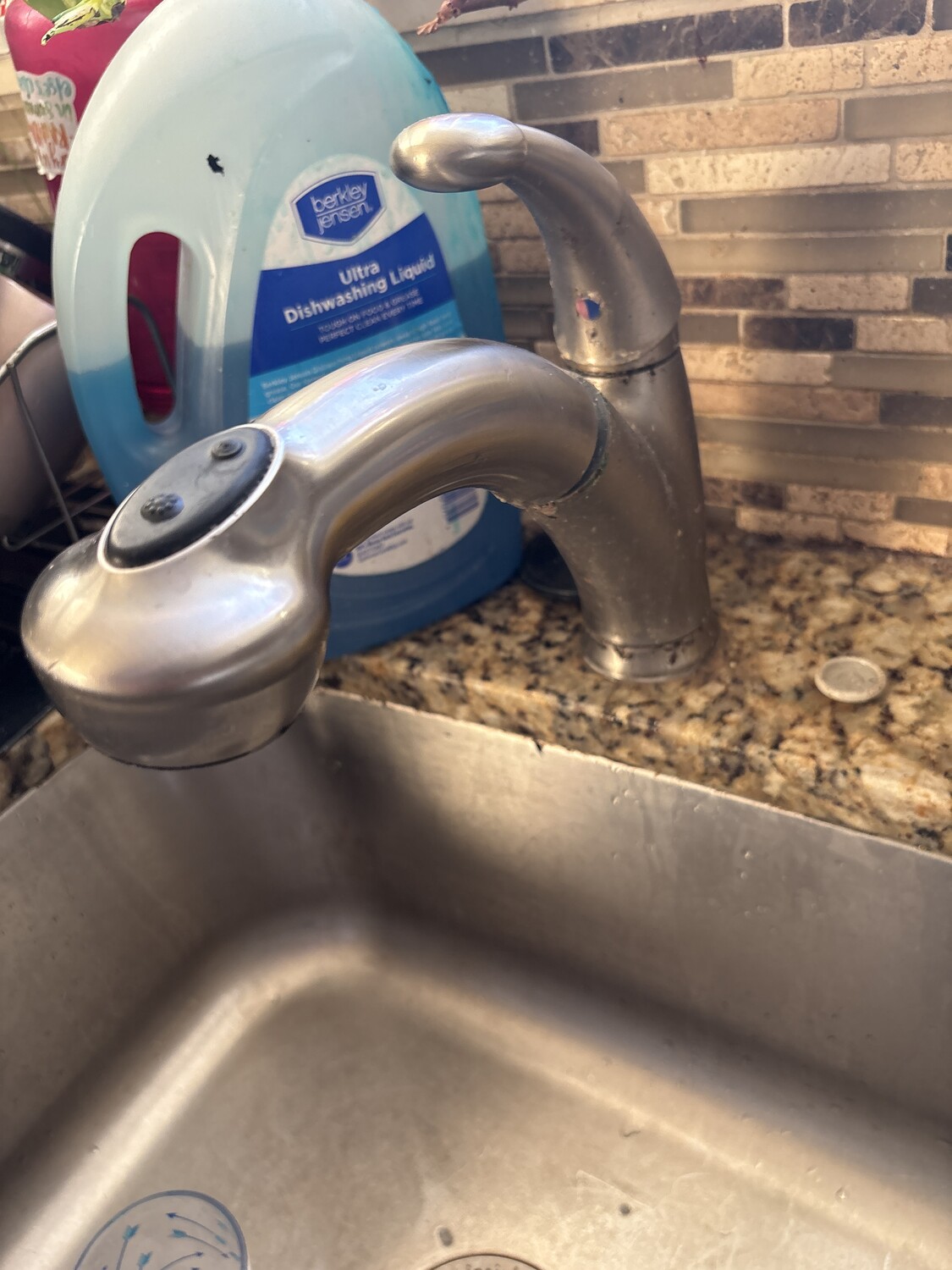
We had two small problems with our kitchen faucet. First, the button that switches between stream and spray had gotten so stiff it barely worked. I am the one who does the dishes, and I never switched it to spray. But every so often, someone else would. Then I would struggle to get it back to stream. Second, the handle had developed a charming new habit of not fully turning off. You'd push it down, the water would keep running, and you'd have to jiggle it into just the right position to get it to stop.
This seemed simple, and it allowed me to avoid what seemed like an overwhelming job: replacing the entire faucet.
Two minor problems. One easy fix.
Famous last words.
Based on my online research, the plan seemed straightforward: Swap the handle, replace the cartridge inside the faucet, done. Everything I read made it look simple. Unscrew, pop it out, pop in the new one, screw back. Shouldn't take long.
I started with the handle. It's a pullout faucet, and the head is supposed to unscrew from the hose. Except it wouldn't budge. So I did what any reasonable person does: I Googled it, watched YouTube videos, asked ChatGPT. Every single source said the same thing. It just screws off. Just screws off. Just. Screws. Off.
So I twisted harder.
I heard a crack.
It came off. Sort of. Turns out there was a small plastic latch holding the faucet head to the hose — and if literally any of the videos or AI tools I'd consulted had mentioned that some faucets work that way, I would have known to just push a button and slide the head right off. Instead, I snapped the latch. Which meant I'd now broken the hose. Which meant I now needed to replace the hose.
Ugh.
I got under the sink. The hose connected to the faucet via something called a “quick-connect fixture,” supposedly designed to detach easily. Nothing about it was easy. I tried every combination of push-down-pull-up-push-up-pull-down the internet could suggest. I took a photo of the connector and uploaded it to ChatGPT. I texted my father-in-law, who actually knows what he's doing. He suggested tapping it. I tapped it. Eventually, after just yanking the thing as hard as I could, it finally separated.
I went to the hardware store. Bought a new hose and a new faucet head. Came home.
The hose connectors didn't fit right. The new faucet head didn’t connect to the new hose—even thought they were the same brand! And when I finally got the head attached, it was noticeably smaller than the original, so it looked completely ridiculous.
I went to the manufacturer's website to find a proper replacement. The faucet had been discontinued.
Fine. I'd at least fix the drip. I bought a replacement cartridge, wrestled the old one out, and discovered the new cartridge didn't come with a retaining nut. The old retaining nut was stuck. I needed another trip to the hardware store.
I want to pause here to remind you: The one thing I had been desperately trying to avoid this entire time was replacing the entire faucet. It seemed like too big a job. Too complex. Too overwhelming. So I kept trying to patch it, piece by piece, instead.
That night I slept on it, and I realized: Even if I managed to get this cartridge working, even if I rigged the broken hose back together, I'd still end up replacing the whole faucet eventually. So I returned everything to the hardware store and bought a new faucet.
The installation took about an hour. Everything connected properly because everything came from the same package. The handle goes up and down smoothly. It turns off when you push it down. The sprayer switches between stream and spray without a fight.
The big, overwhelming job was the easy job. The quick fix was not.
Why We Default to the Patch
The patch feels safer. It's smaller, more familiar, seems like less commitment. We tell ourselves it's the practical choice; the efficient one.
But there's something worth naming here. In my book, I talk about taking small steps — and I believe in that. But there's a difference between taking a small step toward a bigger goal, and taking a small step instead of starting down the path toward the bigger goal. The first is strategy. The second is avoidance dressed up as strategy.
That's what I was doing with the faucet. Every hardware store run, every YouTube video, every ChatGPT query — I was working hard to avoid doing the thing I actually needed to do.
What This Looks Like on Your Team
The same broken-cartridge moment shows up in organizations all the time.
It's the quick all-hands instead of real conversations with real people. It's the email update instead of a structured process. It's the skills training without the mindset work. It's addressing the loudest, most visible resistance while apathy quietly spreads through the rest of the team.
Here's what I've learned from working with leaders through organizational change: Most people think the obstacle is resistance. Resistance at least makes noise. You can see it, address it, work with it.
Apathy is the broken cartridge. It's quiet, it's hidden, and it festers. And it affects far more of your team than the vocal resisters ever will.
Slapping a quick fix on a disgruntled employee feels manageable. But building relationships, having real conversations, breaking down apathy one honest interaction at a time — that's the easier long-term fix, even if the first step feels harder.
And that's the trap. When we're deciding how hard something is, we only look at the first step. If the first step toward the right path feels harder than the patch, we pick the patch. Every time.
What Replacing the Faucet Actually Looks Like
For a leader, it means starting with mindset before mechanics. It means letting people get a clear picture of where things actually stand before pushing them toward where you want them to go. It means getting honest about what your team is feeling before asking them to feel something different.
The approach isn't complicated, but it’s harder to start than just sending another email.
My new faucet works perfectly. Handle up, water on. Handle down, water off. Sprayer switches between stream and spray on the first try, every time. I'll be honest — I look at it with a little bit of pride when I do the dishes.
The thing I avoided because it seemed too big took less time and caused less frustration than the patchwork approach ever would have.
Your teams are the same way. The real process — the one that actually engages people, builds trust, and gets them genuinely on board with change — seems overwhelming from the outside. But once you start, it turns out to be easier, more effective, and more efficient than repeatedly slapping Band-Aids on the same problems.
So let me ask you: What are you still trying to patch?
If this resonates, mark your calendar! My new book drops April 29th, and it contains the full YES AND framework for turning apathetic teams into excited ones. I'm also hosting a free virtual launch party on April 30th. Sign up here: http://avishparashar.com/booklaunchparty/