
I stood in front of an audience last Friday and asked, “what percentage of the US workforce is disengaged?”
People called out numbers: 50%. 63%. 75%. One person said 90%!
The answer? According to Gallup’s most recent survey, 69% of the US workforce is disengaged.
First, that’s a crazy big number.
Second, that is not that far from what people were yelling out. Which means that a) a lot of people are disengaged (or in my terminology, “apathetic”) and b) this isn’t surprising to most people I speak to.
They know it’s there, they know people feel it, and they know it is leading to overwhelm and procrastination (which of course translates to lost revenue from low productivity). They are just uncertain about what to do about it.
The answer is not that complicated, which is probably why most dismiss it:
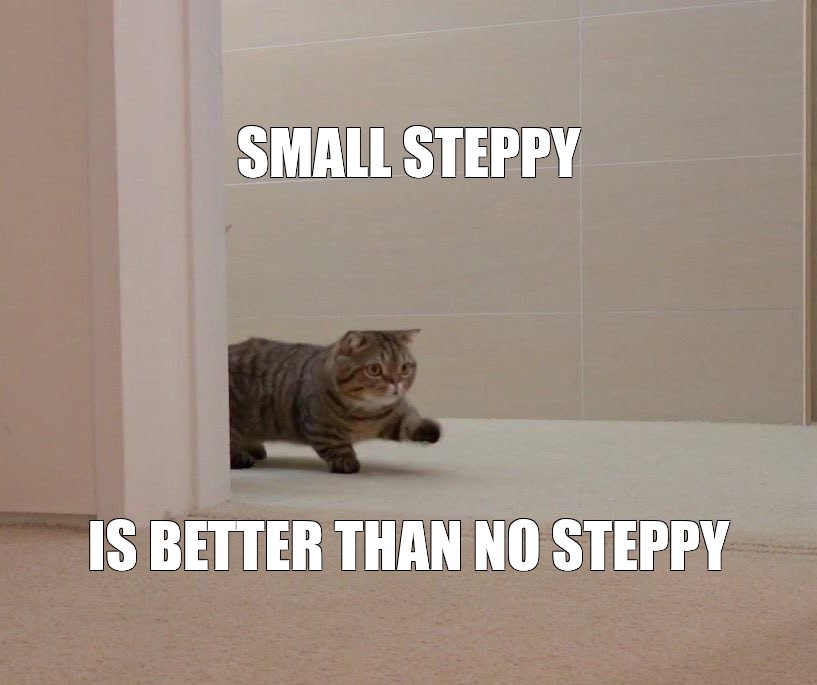
Stop thinking about the whole thing. Just figure out the next step.
That's it. That's the answer people don't want, because it doesn't feel like enough. And yet every time I watch someone actually do it, it works.
I was recently on Juli Shulem’s podcast, The Efficiency Advantage. Juli works with people on productivity, focus, and getting out of their own way. We had a good conversation, and at one point she asked me something I've been asked many times in different forms: What's the one shift someone can make when they're stuck, overwhelmed, or procrastinating?
Same answer. Take the next single step.
Where This Connects to Improv
In improv comedy, one of the fastest ways to kill a scene is to start planning where it's going. You're on stage, something unexpected happens, and instead of responding to it, you're three moves ahead in your head, steering toward the ending you already decided on. The scene becomes stiff. The fun evaporates. And ironically, you usually don't even get to the ending you were planning, because your scene partners took it somewhere else entirely.
The performers who get really good learn to let go of that. They stop trying to control the arc and just respond to the next moment. One beat at a time.
Turns out that's also how productivity works.
When people are overwhelmed, they're almost never overwhelmed by the task itself. They're overwhelmed by how far ahead they're looking. The report due Friday feels impossible on Monday because they're already thinking about the presentation it feeds into, the feedback they'll get, the revision cycle, and whether any of it will matter. The actual next step, opening the document and writing one paragraph, takes maybe 10 minutes.
I've done this to myself more times than I want to admit. Heck, I did it today before writing this article. And the fix is boring: Just identify the next thing. Not the most important thing. Not the strategic thing. Just the next one.
Three Options
In the book I actually break this into three options, depending on how stuck you are.
If you can access it, the best next step is the most important one. The thing with the highest leverage.
But often, when you're really stuck, "most important" is too loaded. It carries all the pressure of the whole project. So you go to option two: the most doable next step. Not the biggest payoff, just the one you would actually do.
And if that's still too heavy, option three: the most fun next step. The piece of the work you have some energy for right now, even if it's not the logical starting point.
I got pushback on this once from a coaching client who said, “I have a family and a mortgage. I don’t have time for fun!” Way back then, as a much less experienced speaker and professional, I let it slide and said, “okay,” and moved on. Now I see how wrong his approach was. Fun isn’t an alternative to productivity, it is a path to it.
I've watched people spin in place for weeks on "most important" and move forward in an afternoon on "most fun." Motion beats paralysis. You can optimize later.
Productivity, Change, and “Yes, And”
This is where the productivity conversation and my actual work start to overlap. Most of what I do is help leaders bring teams through organizational change. And the pattern I see over and over is the same one: People aren't resistant, they're frozen. They're looking at the whole change initiative at once, and it's too big, so nothing moves.
The fix isn't a better rollout plan. It's finding a next step that’s small enough someone will actually take it.
That's true whether you're trying to finish a report or get fifty people to adopt a new way of working. Motion creates momentum. The teams that navigate change best aren't the ones who got the clearest strategy deck. They're the ones who were given permission to move before everything was figured out.
Juli made a point in our conversation that I think was particularly interesting: “Motivation usually doesn't come first. It comes from doing something, finishing something small, and getting that sense of completion. Then it shows up.”
This matches what I see with teams navigating change. The leaders who wait until their people feel ready and motivated usually wait a long time. The ones who find the smallest possible move their team can make and just do that, those teams tend to find their footing faster.
The Power of Boredom
The other thing Juli and I got into, and this one surprised me a little with how much we agreed on, was boredom.
I've been semi-consciously working on letting my kids be bored more. Which sounds like neglect when I say it out loud, but the principle is real: Boredom is where creativity starts. If there's always a screen or a scheduled activity or a parent trying to be engaging, the brain never gets the space to generate something on its own.
Same thing happens with adults, except we do it to ourselves voluntarily. Social media, notifications, the ambient noise of being constantly available. I'm not exempt from any of this. I use an app blocker to literally prevent myself from accessing the internet during work time. Not because I have great discipline, but because I don't, and I've stopped pretending otherwise.
When I actually sit through the first five or ten minutes of discomfort without reaching for a dopamine hit, something shifts. The work gets easier. Ideas show up. It's not magic, it's just what focus actually feels like, which most of us have forgotten because we're so rarely in it.
The Importance of Creativity
One more thing from the conversation, and this one is directly from my book.
When I teach "Yes, And" to groups, someone always asks: Okay, but what goes after the "and"? If “yes” is acceptance and “and” is building, what are you actually building with?
The answer is whatever your creative brain produces. And the problem is most people have lost touch with that. Not because they aren't creative, but because they stopped using it. You grow up, you get serious, you edit yourself before you've even had the thought.
One of the best ways I know to reconnect with it is the morning pages practice from Julia Cameron. Three pages, longhand, pen never stops moving. You might write "I have nothing to say" six times in a row. Keep going. What starts to come out after that is the actual stuff.
I recommend a version of this for any work people are avoiding. Set a timer. Start writing. Commit to not stopping until it goes off. The first draft will be messy. It'll also be done. And because you bypassed the internal editor that usually shuts everything down, the ideas underneath are often better than what you'd have produced by staring at a blank screen for an hour.
The whole conversation with Juli runs about 20 minutes. She's sharp, she asks good questions, and we got into a few places I wasn't expecting. If any of this landed, it's worth the listen.
You can listen to it here. And if you want the longer version of these ideas, including how they apply to teams and organizations navigating change, that's what Say Yes, And to Change is about.
Get Say “Yes, And!” to Change: https://a.co/d/0bcOhrXh
I help leaders turn the hidden enemy of change - apathy - into engagement, creativity, and forward momentum through the YES AND mindset. If you want help unleashing innovation (and actually rewarding it) while creating a culture that approaches change with excitement, contact me now!