
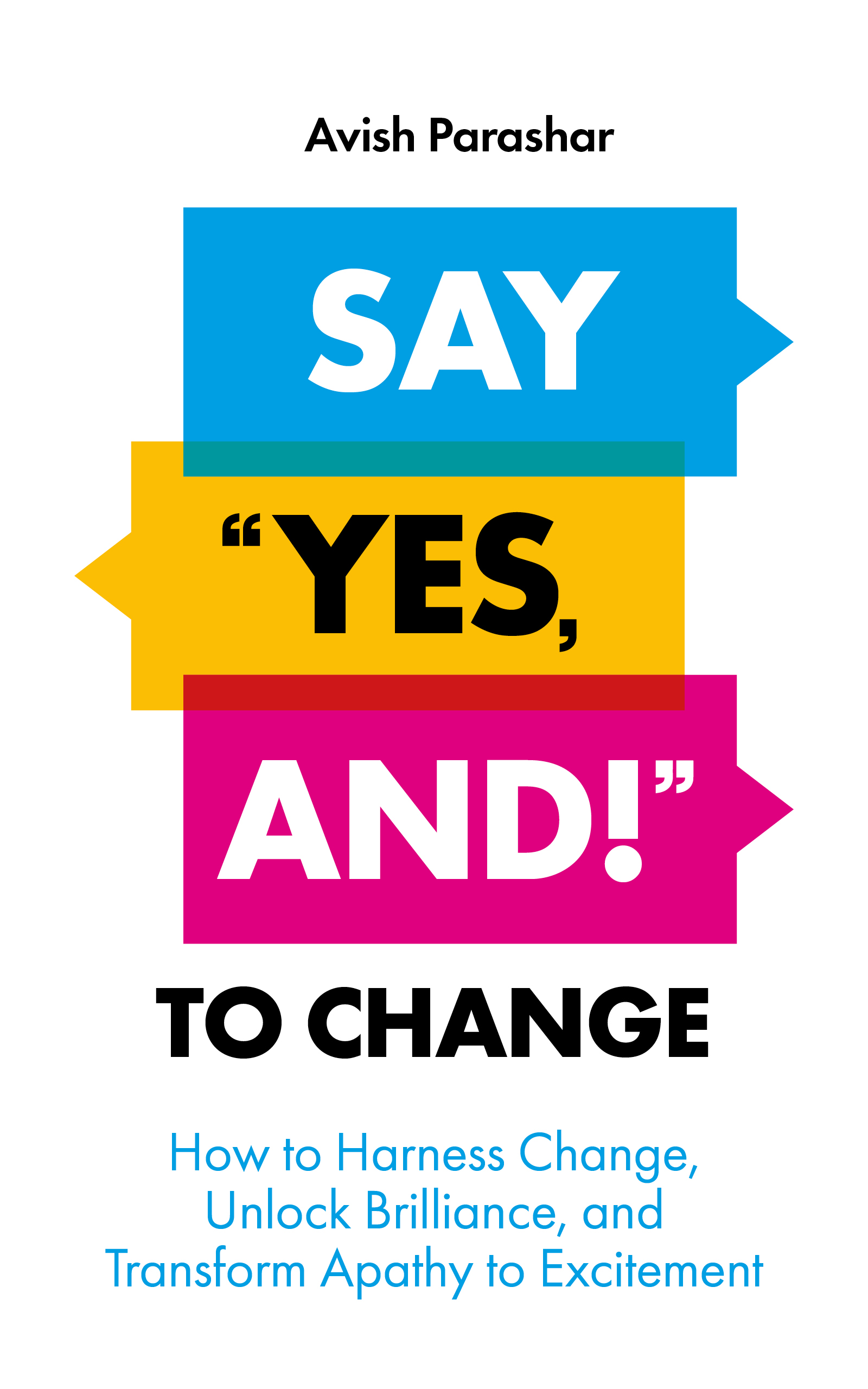
In this solo episode, I’m pulling back the curtain on my brand-new book, Say “Yes, And!” to Change.
For years, I believed the biggest challenge in change was resistance. But after working with leaders and teams across many industries, I realized something surprising:
Resistance isn’t the biggest problem. Apathy is.
Most people aren’t openly fighting change—they’re quietly checked out.
In this episode, I explain why apathy is the silent killer of change efforts and how the improv principle of “Yes, And” can help transform apathy into engagement and excitement.
I also walk through the six-part YES AND Framework from the book—practical tools leaders and individuals can use to harness change, unlock creativity, and create meaningful momentum.
If you’re leading change, stuck in change, or simply looking for a change, this episode will give you a powerful new perspective.
Sign up before March 20th to join the launch team here:
https://avishparashar.com/booklaunch/
Unedited Transcript
Welcome to "Yes And," the podcast where we explore the powerful idea of saying "yes and" instead of "yes but," and how you can use it to harness change, unlock brilliance, and transform apathy into excitement. I'm your host, Avish Parisher, and this is "Yes And."
Hello and welcome back to "Yes And." This is Avish, and I am so excited for this episode, not because I have an awesome guest, which is what I'm usually excited about, but because this is a solo episode. And I'm not excited because I love to hear the sound of my own voice, but I'm excited about the topic of this episode, because this episode is all about my new book, "Say Yes And to Change."
If you've been listening to the previous episodes, you've probably heard me mention it, or if you follow me on any social media platform, you've probably seen me post about it. But for the past year or so, I have been working on a new book, and that book is going to come out at the end of April. So this episode is releasing mid-March. So in about a month, this book is going to be live. But the book is basically done, and what I am doing is collecting ARC readers, advanced reader copies I'm sorry, ARC reader basically is a reader who gets an ARC, which is an advanced reader copy. And I am looking at getting people to read the book for free. I will send you a free digital copy. And all I hope is that you will leave an honest Amazon review when the book comes out. And that's what this episode is about.
Now, no, this is not just a purely promotional episode. I'm not just going to spend the next 5, 10, 20 minutes trying to convince you to go join the ARC team or buy the book. I'm going to explain what the book is all about, and then go through the key framework in the book and give you some content right now. So even if you don't read the book, which I hope you will, you'll still get some value by listening to this episode.
But as I said, this episode is dropping on March 16. And the basic deadline to sign up to be an ARC reader to get a free copy in exchange for hopefully leaving an honest Amazon review is March 20. So you've got this week. So if you are listening to this before March 20, if you go to avishparisher.com/booklaunch, you can still sign up. And I'm going to put that link in the show notes. Now, if it's after March 20, there's a chance it might be open for a couple of days later, or there might be some more information there. So if you're listening to this after March 20 and you're still interested in the book, go to that link anyways, avishparisher.com/booklaunch, and you'll see what the latest kind of promotion is that you can get there. So that's the general information about the book launch.
Now I'm going to get into a little bit about the book itself. So my last book I wrote was called "Say Yes And." You may have read it. And that came out in 2012. And I loved that book. And it was written for a very specific purpose, which was to give people an overview about the idea of "Yes And." It was a very mindset sort of book, very motivational, and frankly, a little short. And that was by design. And I loved it. But I always intended to write a deeper dive book relatively soon after.
And of course, dang happens, and we have the best of well-laid plans, because now it has been 14 years later. And so about 12 years later, at this point in 2024 well, even before that, I started just brainstorming using index cards and reading books, and just not with a specific goal in mind, but just starting to gather ideas for what I assumed would be a book at some point. And that was probably in 2022. And then life happens. I got a little distracted and sidetracked. I had a baby in 2023. So then it was 2024, early 2000 no, mid-2024, I started picking up the brainstorming again. And then early 2025 is when I really decided in earnest, OK, I'm going to write a new book. And that's when I jumped into it.
Now, of course, being not so young, but still impetuous and ambitious, I assumed that I would write the book quickly, finish it by the summer, and then have it released in the fall. Well, that didn't happen. And part of that was a different approach, because as an improviser and as someone who talks about the power of speed when it comes to creating, I can crank stuff out pretty quickly. But my goal here was not just to write a book, but to write a good book and a useful book. So I brainstormed a lot. I edited a lot before I wrote. I really edited the outline a lot to really shape the outline. And then I spent a lot of time in the writing process.
But the writing process in and of itself was actually relatively quick. Then what took longer was the editing process, is going through this and editing it down and shaping it and crafting it. And I'll tell you, there are so many times that my sort of wanting to be done, hey, 80/20 rule, which is good in a lot of things I'm going to write about that in a future post but my good enough, right? And I think in many cases, doing something that's good enough is great. And that's what we need to do. I think sometimes we obsess over perfectionism. But for this project particularly, I spent a lot of time editing, even when I wanted to just give up and ship it, because I'm like, well, a little bit better is going to really help this take this to the next level.
So I thought we pushed the what I assumed was going to be a launch date of like September or October to March. And then I realized, oh, hey, Avish, you forgot to budget in any time for beta readers to read the book. So I had to push it yet another month. But now I'm on track, and it's all pretty much done. And we're just getting ready for the launch. So that's kind of where the book came around.
Now, why this book? Well, as I said, the first book was an ideal book. Well, that was my second book. But the previous "Yes And" book was an ideal book. And it was very motivational, and I loved it. But what I decided I wanted was a book that was still entertaining, engaging, and motivational to read, but more tactical. I wanted a leader or an employee to have this book and be able to read it and really do something with it, and to almost serve as a reference manual at times, something you could keep on your desk because to have action items and things you could do and exercises. So I tried to weave all of that in. And I also wanted to do two things.
One, I wanted to go deeper into not just the idea of "Yes And," but the how of "Yes And." So how do you implement this? So I wanted to go deeper into that. And number two, I wanted to codify a lot of the things I had been talking about and the frameworks I had developed over the years. So obviously, I've been speaking about improv and "Yes And" for a long, long time. And the ideas in the book are all things I have spoken about or done training programs on or coached people on. But I never quite gathered all the information and coalesced it into a framework, into a pattern, into a system. And working on a book like this really forced me to do that, whereas previously, it would just be a nice-to-have. And I'll get some ideas and put them together. But this really helped me shape all my ideas. So this isn't all just theoretical stuff I threw in the book. It's all stuff I have worked with groups on and tested and talked about. But now it's put together in a very sort of logical, organized, easy-to-digest way. So that's the origin story of the book.
So what is the book about? Well, its title is "Say Yes And to Change." And you're like, oh, great, Avish. Now you've got another book on the market on change. There's plenty of those. Why do we need another book? What's different about this one? Well, there are a couple of things that are different. Number one, obviously, my entire differentiator is the applied improvisation. So I approach change through the lens of improv comedy and "Yes And," which is in and of itself not unique because there are other people who do applied improv. But I think when you combine that with what I believe to be the big differentiator of this book is if you look at the subtitle, the book is "Say Yes And to Change." The subtitle is "How to Harness Change, Unlock Brilliance, and Transform Apathy into Excitement." And I think that subtitle right there is the differentiator, apathy into excitement.
As a speaker and trainer, I spent many years thinking my job was to transform people who were or to take people who were resisting change and get them to accept it. And over time, I realized that's not really my goal. It's not really what excites me. And that's not where the opportunity is, because yes, there are people who are resistant and hostile to change. And you have to address those. But if you think of a bell curve, the middle 80%, they're not jumping in and embracing it. And they're not resisting it and being hostile to it. They are apathetic. We are in a world where we are overwhelmed, overworked, change is constant. And people tend to shut down. And frankly, the modern era of technology and distraction also makes us reach for quick dopamine hits, which actually increase the sense of apathy. Instead of doing things that might increase our engagement, we do things that sort of just zone us out for a while. But then we never get into that engagement zone. And so apathy just increases. And what I realized is that this idea of improv comedy, of "Yes And," is really the cure for apathy.
If you are leading a change or if you're going through a change, your biggest challenge isn't resistance. It's apathy. And apathy is bad for two reasons. One, as I said, the bulk of people are going to respond to change apathetically. So that's your biggest challenge and your biggest opportunity. But number two, apathy can be incredibly dangerous because we don't see it. When someone is resisting change or even hostile to change, yeah, it's annoying. But you see it. You can address it. You know it's there. But apathy? Apathy often goes undetected because it looks like compliance. People sit in their meetings. They nod along. They do their work. They say, yeah, sure. But underneath, they're checked out. They just don't care. They're doing work that's less productive. They're maybe looking for other opportunities. And so they'll leave, right? They get burnt out. So apathy, not resistance, is what we want to address when we are responding to change.
So how do we do that? How do we transform apathy into excitement? How do we harness the change? How do we use change as an opportunity to unlock brilliance rather than something to get through? Well, that leads to the bulk of the book, which is what I call the "Yes And" framework. I took "Yes And," the six-letter, two-word phrase, and turned it into an acronym. And then six chapters of the book go through each letter of the acronym, what it means, and most importantly, what you can do with it right away, and not only what you can do with it as an individual dealing with change, but what you can do with it as a leader if you are leading the change.
So I'm going to quickly go through the six steps in the framework. And again, remember, if you want the full in-depth, there's a full book, like 250 pages. Go to avishparisher.com/booklaunch. If it's before March 20, you will definitely be able to join the advanced reader team, get a free copy in exchange for what I hope will be an honest Amazon review. And I can't even force you to do that, so you can just get the free book. But I hope you'll leave an honest review. And if it's after March 20, you might still be able to get on the ARC team, depending when it is. And if not, when the book first launches, it's going to be available for a big discount. And if you're listening to this much later, you can still go there to get information about the book itself. But right now, I'm just going to give you the quick overview of the content in the book.
So "Yes And," the first one is why, yield to what is. And the more expanded form of that is yield to what is, let go of what was, build towards what can be, right? So when change happens and I have noticed this, one of the biggest challenges people have is they just don't yield to it. Now, yielding doesn't mean you give in. It doesn't mean you just go along with whatever and give up on your goals and the future. It just means, hey, you have to accept the current reality. And I love the word yield, number one, because it starts with a Y. And that helps me with my framework. I'm not going to lie. It's all about branding and marketing. But I love yield because if you think about the word yield, if you're driving, when you hit a yield sign, it doesn't mean you stop. It doesn't mean you give up. It means you pause. You accept the reality, which is, hey, other cars are coming. And when there's an opening, you go forward. And I think that is the approach we need to take in the times of change.
When change happens, many people don't yield to it. They resist it, or they're like, oh, I can't believe this happened. Or they look to the past. I wish we could go back to the way it was. And the first step is just accepting reality. OK, this is the new reality. Now let me wait for my opportunity to move forward. So that's why the second part is let go of what was, yield to what is, let go of what was. So many people are holding on to the past, whether it's more mental, like just keep thinking about the past, or even external and more overt, like trying to actively go against the change to be like, well, I'm just going to keep doing things the same way. So we have to let go of that.
And then the final step is to build towards what can be. If you just yield to what is and let go of the past, that's great. But you're not really accomplishing anything at that point. So you have to build towards what can be. You have to think about a future that's bigger and better. And there are two ways of doing this. One is with the change, ask yourself, how can I use this change to my advantage? Not just how can I get through it? How can I use it to make my reality even better? And the second thing and this is one of the topics I'm really excited about in the book. And that is to set an impossible goal. I love impossible goals. And there's a whole section in there about smart goals versus impossible goals. I'm not going to spoil it here. But impossible goals are what stir your soul. There is the goal that when you think about it, your first thought is, yeah, but. Yes, but I don't know how I'm going to achieve that. Or yes, but I can't do that. Now, when you set that as your goal, that has the power to stir your soul because when you set an impossible goal, you have to get creative. You have to innovate. You have to try new things. You have to learn and grow. And that creates engagement, right? I think engagement comes not from doing less, but from doing more of the things that light you up. And when you set an impossible goal now, the key here is it has to be a goal that you really care about, that when you think about it, even if you're like, I don't know how I could do it, it excites you. It can't just be a goal that's strategically sound or that you think you should do. But when you do that, even though it's sort of adding more to your plate and adding challenge, it's engaging challenge. So this is one of those first steps. And how do we transform apathy into excitement? Well, you've got to get yourself excited about something. And that's an impossible goal. Now, if you're a leader, be cautious. You cannot set an impossible goal and then roll it out to your team because that's just going to overwhelm them. You need to get their involvement. You need to talk to them, ask them questions. When people buy in, though, then you get synergy, and everything moves forward. So that's the first one, yield to what is.
The second step I won't even say step. It's a second piece because you can do these in any order. They're not sequential. So the second piece of the framework is E. And that is to explore and express your core. We all have a core. And that is the thing that is you, right? What are your strengths? What are your weaknesses? What do you love? What are your passions? What are you drawn to? What are you curious about? The problem is many of us lose touch with this because we become very practical. And we just do what we need to to get through the day. And then we start sort of masking ourselves to be more acceptable to others. And the more we do this, the more we lose sight of our core. The problem is that your core is your inner genius. Your core is all of your unique strengths. Your unique ability is all in your core. So number one, when we don't use our core, we're not operating at our full potential. Number two, when we're not using our core, we are not engaged, right? This is where apathy comes from. It's if I'm going to work and just going through the motions, doing stuff that doesn't feel like me just to earn a paycheck, I'm going to be apathetic about it. So number one, we need to explore the core. So many people never take the time to really ask and figure out, what is inside of me? What are my strengths and loves and weaknesses? And then we have to do something with that, which is the second part, which is express your core. If you can find little ways at first through your day to do things that are expressing your core, that are you operating at the level of who you truly are, this will improve your output. It will improve your engagement. And it will increase the likelihood that you will enter the flow state, which is this amazing state where time sort of goes by quickly, and you do your best work, and you feel super energized. I talk more about that in the book. I didn't pioneer the concept. But I'll explain it in the book. So definitely go check that out if you're interested. So that is E, explore and express your core.
Then we move to the S, which is start small and take small steps. And I have been talking about this since my very first presentation, gosh, I don't know, 23 years ago, whenever it was. Start small and take small steps. One of the hardest but most important things for an improv comedian to learn is the power of focusing on the only thing they can control, which is their one next step, right? Yeah, you can have big plans. You can have impossible goals. But if all you focus on is the impossible goal, you'll never get started. Just think about, what is my one next step?
This is what improv comedians do. You know I've done improv for a long time. And you always get yourself in trouble when you plan ahead, when you start saying, oh, here's where the end of the scene is going to be. This is going to be the big punchline at the end of this story. And there is a story in the book where I really explain this about an embarrassing incident in an improv show I had. My whole group had this terrible improv show when there were reviewers in the audience because we all sort of did this. We all had this punchline at the end we thought would be really funny. But it made the rest of the scene just abysmal.
So we want to focus on just what is the one next step I can take? And in the book, I talk about three next steps. One is, what is the most important next step? You've got a bunch of stuff. It's overwhelming. Just ask yourself, what is the one most important next step I can take? Now, sometimes, most important next step seems overwhelming. So instead, you can ask yourself, what's the most doable next step? And this kind of can manage your moods and emotions. Maybe the most important next step is one that just still feels overwhelming, even though it's a small step. Well, what's the most doable next step? Maybe I can't sit down and write for 20 minutes. But maybe I can just pick up the phone and call someone I needed to about this idea. Whatever it is, what's a step you can and will do? And finally, the third option is, what's the most fun next step?
Fun is something we often feel we need to leave at the door when it comes to work. But especially when it comes to transforming apathy into excitement, if we spend a little bit of time saying, you know what? I've got all these things to do. I've got this impossible goal. I've got so many steps I can take. What is the most fun one right now? And again, this kind of manages your mood. If you're very focused, feeling really good, really energized, maybe you go for that most important next step. Maybe if you are feeling a little overwhelmed and stressed, you go for the most doable next step because you're not feeling super motivated to do the high thing. But by taking a doable step, you'll feel you've made some progress. And maybe you're not feeling either of those, just sort of feeling that ennui, that apathy. You're like, well, I know I should work. What should I do? Well, then say, what's the most fun thing I could do? Let me move this forward, right?
So we identify the next step. And then we take it. And the benefit of doing this is that of small steps is that it lets us do what I call AAA, act, analyze, adjust. So you take an action. You see what happens. And then you make an adjustment. And then you take the next step. And you see what happens and make an adjustment. So if you think in terms of tiny experiments, right, we keep making progress, but not linearly, but sort of in a jagged line, which is great because, number one, it keeps you going in the face of constraints and obstacles. And number two, you're improving the process as you go. Instead of making a plan and then sticking to it no matter what, you could end up somewhere and be like, oh, this plan was flawed from the beginning. But if you pay attention to the results you get as you go and make adjustments, then you'll end up somewhere potentially even better than your original plan. And I do have a story in the book about this daily blog I did, which really I should have abandoned way earlier than I did. But I never did this. I never set boundaries and guidelines for when I would adjust. And I never did. And three years went by. Didn't book any business and wasted so much of my life on that. So that's S, start small.
Then we move into the A, which is access and apply your inner creative genius. I believe all people have an inner creative genius. We just lose touch with it, right? We are told from a young age to pay attention, to watch what we say, to think carefully before we open our mouths. And all those reminders are great and useful. But what they do is they help us develop these filters, which is this conscious evaluative process. And that filter is useful in that it keeps you from saying something stupid or getting into trouble. But it also cuts you off from your creativity. So in the book, I go over how everyone is creative. And I give you tools and exercises to retap into your creative genius because in order to go after an impossible goal, in order to solve the problems that have vexed you for a long time, right, in order to really see the opportunity and change and to unlock your own brilliance, you need to access that creativity inside of you. This is where you come up with the new ideas and innovations. So the whole chapter goes through how to access it and then how to apply it as well.
And the ancillary benefit of this is that I have found that regularly applying your creativity is how you get in that flow state. And it is how you transform apathy into excitement. When you tap into the creative flow, you get energized. It's exciting, right? So the more opportunity we have to do that, the more opportunity you have to move into that excitement stage instead of being apathetic about it. So this is a big topic. I've talked for years about creativity. And I love it. And I go in depth into it in the book. So really, if you want to access your inner creative genius and use it as a way to really transform that apathy into excitement, you want to read that chapter.
Then we move on to the N, which stands for notice and nurture emotion. Now, I know. I know. This is a book for leaders and corporate environments and professional groups and obviously non-corporate as well, association, nonprofit. Any leader, any employee going through change can benefit from this. But in a lot of those environments, we are all taught, if you're like me, you've sort of heard the message, whether explicitly or implied, that feelings don't matter, that emotions have no place at work, that you should leave your feelings at the door and just do it. It's like, I don't care how you feel. Just suck it up and do it. And yeah, I understand why we have that. But it's just not true because those exhortations forget one important thing, that we are all human beings. And as humans, we are all emotional creatures. And whether you stop people from expressing their emotion or not, they're going to feel them. And this really manifests itself in two ways.
Number one, you have to notice and pay attention to your own feelings. By not acknowledging, noticing, and processing your own feelings, you end up making emotional decisions. What's funny is that people are like, I don't care about your feelings. They're usually saying that from a highly emotional state. So they're not saying that feelings don't matter. What they're really saying is your feelings don't matter because they've never taken the time to understand and process their own feelings. So understanding in the moment, how am I feeling? And is this the most useful feeling for me to have in this moment? Because a lot of times, we'll go into a situation angry when anger is not the most useful emotion for us to have. Or we'll go in feeling nervous when that is not the most useful feeling for us to have. So starting to notice and process your emotions is a first step.
And then to nurture. To nurture it is to find ways of engaging in the emotion that you need. So if you know that you don't want to be angry, you want to be more positive, what can you do to nurture that positive emotion? And there are techniques in the book for that. Now, you can also do this as a leader, right? Obviously, noticing yours. But it's almost even more important as a leader is just being aware of how people are feeling on your team and also what is the impact of your actions on their feelings? Are you making them feel worse or better, which leads to productivity, which leads to burnout, which leads to retention, and yes, which leads to apathy? And think about it. Both apathy and excitement are what? They are emotions. So if our goal is to transform apathy to excitement, of course, we need to notice and nurture the emotions. We need to notice when people are in apathy. And we need to nurture the feelings of excitement.
So this, I think, is the secret sauce of improv comedy because yeah, some people talk about it. But when I learned this in improv, it transformed my improv performance. And it's something I don't actually see talked about as much in the improv world and certainly not in the business world or professional world. And this could be your secret sauce as an employee or as a leader.
Finally, the sixth piece of the framework is D. And that is dig deeper, right? We want to not just move on to the next thing immediately but really engage. And this is where the heart of yes and comes. Yes, but is surface level. You start saying something. And I say, yeah, but let me cut you off there. Yeah, but let me explain my point of view. Yes and is digging deeper. Yes and tell me more about that. Yes and what do you mean by that? Yes and explain more, right? Because a lot of times, when someone comes to you with a problem, an issue, or a complaint, that's a surface level thing. And if you just say yes, but you keep the focus on the surface. But when you say yes and, you can dig deeper and uncover what is the real objection? What is their real concern? What is the real emotion, for example, right? Using that to dig deeper.
And we do this with a very simple technique. And that is to ask questions and listen to the answers. On this podcast, you've probably heard me say this. If you've been a regular listener, I have spent every interview, so many interviews where I'm talking to people who are leaders, the ultimate brilliant secret leadership technique they use is, well, I ask my people questions. I listen to their answers. And then I do something with their answers. That's it. And that is the heart of digging deeper. Now, we use this in improv comedy with this idea of advancing versus expanding. You don't always need to jump to the next idea in improv. You can explore the current idea more and make it bigger and dig deeper into that. And that is where richness comes in. And that's what often leads to the next best idea is when you don't just jump but when you first dig deeper.
So those are the six steps in the framework. They make up the acronym. The acronym makes up the word yes and. There is a visual framework in the book. There is something called the change response ladder, which takes you through the six stages of change, which is hostility, resistance, apathy, hesitation, acceptance, and excitement. And understanding that you don't have to go from the bottom to the top all at once but just moving up the ladder can yield impressive results, I think, will be very helpful. So if you are a leader tasked with leading a change, if you are an employee stuck in change, having to deal with change, or if you are just an individual who feels like you could really use a change and want to create a meaningful change in your life, this book is for you.
So once again, if you are listening to this before March 20, go to avishbharsha.com/booklaunch, sign up, join the launch team. You'll get a free digital copy. And all I ask is that you will hopefully leave an honest Amazon review when the book comes out. If it's after March 20 but close to it, you can still go there. The sign-up form might still be open. If it's not but it's still, say, in April, you can get information to get the book on Amazon at a huge discount. It'll only be $0.99 for the launch month. So you can get it right away. And if it's after that, well, the page will still have information about the book. And you can still get it because even at the full price, it'll be well worth your time to read if you take the time to understand and apply the ideas.
So thank you very much. Just a quick recap. Remember, change is an opportunity to unlock hidden brilliance. The key to doing that is to say yes and. You say yes and to change. You say yes and to others. And you say yes and to that. And when you do that and start applying all the ideas in the yes and framework, you will start to transform apathy into excitement, not just for yourself but for your team and your entire organization and culture. Thanks for listening. And I look forward to seeing you next time on Say Yes And.