
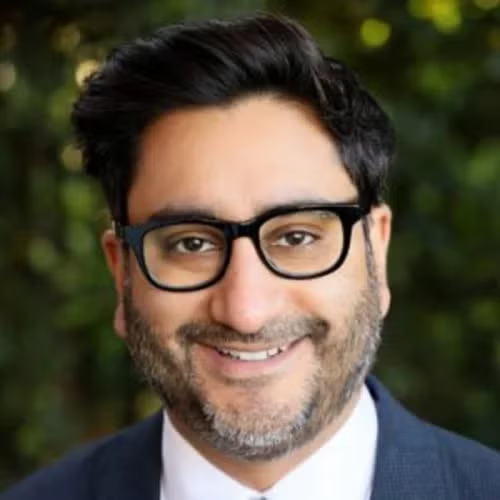
In this episode, I sit down with my longtime friend (all the way back to childhood!) Dr. Anish Mahajan for a fascinating conversation about leadership, listening, and leading through uncertainty.
Anish has led at the highest levels of healthcare and public health, from helping implement the Affordable Care Act to leading a major public hospital through the COVID crisis in Los Angeles.
What I loved about this conversation is how much of it applies far beyond healthcare.
We talk about why great leaders listen first, how to navigate skepticism and resistance, what it means to lead with humility, and how to make decisions when the stakes are high and the answers are unclear.
Whether you lead a team, run a business, or are simply trying to respond better to change, this episode is packed with practical wisdom.
Key Takeaways
Great leaders listen before they lead
Relationships are foundational to effective leadership
Skepticism and curiosity can coexist
In times of crisis, leaders must return to the core mission
Leadership requires both collaboration and decisiveness
Change is easier when people feel heard
Sometimes the hardest path creates the biggest impact
Links
Connect with Dr. Anish Mahajan: https://www.anishmahajan.com/
Subscribe to the podcast: https://pod.link/1767790956
- Virtual Book Launch Party for Say "Yes, And!" to Change: https://avishparashar.com/BookLaunchParty
Unedited Transcript
Avish: Hello, Anish, and welcome to the podcast. How are you, buddy?
Anish: I am well. It's good to be here.
Avish: It is very good. And now I say this, I've said this multiple times over the recordings of these shows, but you now have the record of the person being on my podcast who I have known the longest. I've had a bunch of people from college, some people even, I think, my freshman year in college, but you go all the way back to, gosh, even before high school, I think, right?
Anish: Did we even hit puberty? I don't know, but.
Avish: We went through it together. Well, not.
Anish: I am honored.
Avish: Not together, but.
Anish: Yeah, let's be clear, not together. At the same time.
Avish: Well, we are going to get into how we know each other and growing up and all this stuff. But for people who are listening and who have no idea who you are, could you just give us like a one-minute sort of who you are and what you do?
Anish: Sure. Let's see. I am a physician, an internal medicine doctor, but mostly I spend my time trying to improve healthcare systems.
Anish: And I've had the opportunity to look at our, frankly, broken healthcare system from many sides of the elephant, from being a primary care doctor, seeing patients, from being a professor at UCLA in health policy and management, to helping assist on putting together the Affordable Care Act or Obamacare and working at the White House in 2009 and 2010, to now eventually running a public hospital during COVID here in Los Angeles, and now helping lead public health for LA County.
Avish: So that's a very impressive resume. You've done a lot of stuff. It's funny, though, I started to laugh a little bit when you introduced yourself as a physician, because I believe when you were going to, even when you were planning to go into med school, I was, knowing you then, I'm like, you're not going to be a doctor. And yet.
Anish: And you were right. I mean, I think, you know, I used to say, I tell everybody, the only reason I'm a doctor is because my parents expected me to go to medical school, and there are no doctors in the family. So pressure was on.
Avish: Which is fascinating, because my dad would have loved me to go to medical school, and he was a doctor, and I went a completely different path.
Avish: Well, one of the things I think is interesting about that, and you know, these conversations don't really have an agenda, so we're already off on a tangent, but what I thought was pretty cool is what I figured out not that long into this process. I'm like, you're not going to be a doctor. You have no interest in doing that. But you did even, all the way back then, have sort of a passion for healthcare policy.
Avish: And your whole position was, either I can't do that without being a doctor, or being a doctor is going to give me a much better ability and perspective. And I think that's interesting, because I think so many people, myself included, tend to kind of veer towards the easy path. Like, well, that's hard, but I could probably do it if I go this other way. But you kind of went for literally the hardest route possible to get to your career.
Avish: So kind of, I'd love to hear your, I don't know if we ever talked about this, but your sort of thought process on kind of like what made you decide that, yeah, I'm going to go through four years of college, four years of med school, residency, all that, just so I can do this thing that's, you know, not being a doctor.
Anish: Yeah, that's a good question. I haven't thought about it. I mean, I guess I'd say that, you know, somewhere along the way, you know, being a student turned out to be a lot of fun. I think learning, I think I actually.
Avish: It's a professional podcast, so we won't go into why.
Anish: But yeah, I guess I'm that kind of nerd. And so, you know, that was part of it, I think. You know, why did I, you know, frankly speaking, I would say, you know, I'm overeducated. I have too many degrees. I have multiple masters, you know, and it's kind of nonsense when you look at it. But I think I enjoyed being a student. It's kind of a gift to be learning. So that's one thing.
Anish: I'd say, why did I take the hard route? You know, for me, I don't know if I thought of it that way. I kind of, I guess I probably thought of it as, I don't know, this is the route to the end goal. And I guess you're right. Like, the end goal for me is to, I think it's always been to try to see if I could maximize my impact. And I don't know why I had such, you know, self-aggrandizing thoughts about myself going way back to when we were teenagers. But that was the reason.
Anish: So the path said that I got to go this, this, this, and this. So that's sort of what I did without considering alternatives.
Avish: And there's almost a brilliance in that. It's almost like, and it's kind of the arrogance and idiocy of youth, right, where you're like, you don't really know what you don't know. So you don't really think it through. You just sort of, you don't overthink it, right?
Avish: You're like, oh, well, I want to do this. I guess I'm going to go do this. You know, but if you're like 40 years old, then it's like, well, do I want to do that? Do I have time and energy? So, you know, maybe because you were so young, it was just like, all right, I guess that's what I'm going to do now.
Anish: Well, that actually, you know, really resonates with me, because I think that, you know, I didn't, you know, things that came at me when I was younger, I was like, yeah, I'd like to do that. Yeah, I'll do that. I'll do that.
Anish: Now I find myself wanting to say no as often as I can, so that I can just stay at home and hang out on the couch when I can, right? Like, now, you know, I want to reduce the complexity of my life. Whereas before, when I was young, it was like, well, these new and exciting paths, why not try them?
Avish: Well, it's funny, and we were kind of talking about this a little bit before we started about kind of, you know, stories from our youth and whatnot. And, you know, you and I, we went to different schools, but we knew each other, you know, because we were Indian in Poughkeepsie, New York, so, and our families were good friends.
Avish: And then there was a moment that I think sort of changed the course of my life. And I don't know if you remember this, and I have, as I'm working on keynotes and new material, I'm always like coming back to this story, and I have not figured out how to wait to make it work like in a keynote format. But, you know, in our community, there were these community plays that Indian groups would put on.
Avish: And you were involved in them, and I wasn't, but I was involved in theater in high school. And you were over my house, like our families were together, and we were shooting baskets in my driveway. And we just started a conversation. And one of us, I forget who, just said, what if we ran it ourselves next year? Because up to this point, like the Indian aunties, the adults kind of ran it. And we were like, what if we do, we could, you know, the arrogance in you, we're like, we could do a better job than them. And from that germ, we just did it.
Avish: And that really changed my life, because I wasn't super into the Indian community. And from that moment, I got more into theater. I got more into Indian. And that idea of like that increase in complexity, just doing whatever happens. So A, number one, I don't know if you remember that story. And B, if you kind of see how that sort of parallels this idea of just sort of jumping in and doing things and just kind of seeing where it leads.
Anish: Yeah, you know, I think that's a really interesting thought to bring up, because it really represented for both of us this kind of, you know, let's actually go and run toward a wall and try to do something that hasn't been done a little crazy for us as, you know, 13, 14-year-olds saying that we're going to try to pull off something that adults used to do. And, you know, you certainly weren't trying to go out the easy route that way. I mean, that was going to be the hard route.
Anish: And I guess it definitely, if I think about it, there's so many parts of my life where I've done exactly that, where I've sort of stepped out and said, well, why don't we try it this way, even though it's never been done? You know, who says that we can't set up a community, you know, you know, I helped found a community health information exchange here that's not affiliated with any specific government agency or any specific community organization, but a conglomeration of a collaboration of entities saying that we need to do this thing and, you know, share health information across, you know, different companies and different hospitals and different systems that are usually competitors, because it's important for the community.
Anish: There were so many people who said, that's crazy. Like, why would you, that's not going to work. And why would you try to do that? I feel like we heard exactly that when we were teenagers saying, oh, yeah, we're going to, you know, rent a U-Haul. Neither of us had a driver's license. We're going to find somebody older than us to rent a U-Haul, you know, somebody's older brother to drive it. But we're going to direct the fact that we need a U-Haul for these numbers. Again, we used to, you and I did some things that, you know, frankly, I think sort of shaped what, you know, how I thought about things in the future.
Avish: Well, I'll look at this community kind of coalition thing you made. Which job, was that your current job you did that with or a previous one?
Anish: That was just a side passion project.
Avish: Oh, you just, oh, so when you talk about how you used to just add complexity. So you were a, so how long ago was this that you.
Anish: So this was, you know, in my first job after I left Washington, D.C., when we were implementing, you know, what became the Affordable Care Act, you know, when we were trying to expand health insurance coverage to people who are uninsured in LA. These are people who are generally low-income, facing lots of social challenges. What the Affordable Care Act did was enable them to get insurance when they couldn't get it before.
Avish: Yeah.
Anish: And so I was part of the healthcare system leadership team here, public healthcare system that runs clinics and hospitals, you know, making sure that we built a system where patients could get their care. But the problem was that, you know, if you're a patient who's got Medicaid insurance, you're not paying copays usually because you're too low-income. So if you're supposed to go to in-network hospital, one of our public hospitals for care, sometimes, you know, and if you end up going to the commercial hospital down the street or community hospital down the street because it's nearby or the wait time was less, basically you were going out of network.
Anish: You know, if you or I go out of network, we got to pay a higher copay. We got all these things that make us stay in network. But people who are lower-income, their lives are complicated. They have to work during the day. They can't get time off. So they end up at some other, somebody else's clinic or hospital. And then we would have to pay those bills to the other hospital, and it would be very expensive for us. So then we'd have less money to make our health system good.
Anish: So there's a problem of health information. Like, there would be this health information on a patient at some other hospital's computer software. We couldn't even see it. And so we decided, you know, that we needed to solve this problem. We needed to make sure that whether, regardless of which company a hospital is affiliated or the government, they needed to share this information so that, you know, a patient's, you know, who's taken care of at Hospital A and Hospital B, the providers and nurses on both sides know what's happening, what happened at both of those places.
Anish: And it was out of that that, you know, we said we need to solve this problem. We created a 501(c)(3), which turned out to be this thing called lanes, because LA is full of highways and freeways. But, you know, it's an acronym. But basically, it's to say, you know, health information should freely flow, even between competitors, so that patient care can be better. And so that was like a side project while I was helping run the health system.
Avish: Well, let's get into that a little bit more, because, you know, the thing I haven't mentioned so much of what we've been saying is essentially what I talk about now, this idea of yes and versus yes but, and how so many times will people just say yes but to themselves. And, you know, what we did as teenagers and what you've done here is you kind of said, well, yeah, and let's, instead of looking at the reasons why not and saying yeah but, it's like, well, yes and let's do it and see what happens.
Avish: I'm curious, though, you are talking about sharing information amongst competitors and all these people are like, oh, that's not going to work. So what was the initial response when you went to some of these competitors and were like, hey, let's start collaborating in this way? Were they open to it initially? Was there pushback? How did you kind of overcome some of that hesitation or resistance you might face?
Anish: Yeah, I mean, there were a lot of different opinions. But overall, you know, it meant that I learned, I had to learn how to make the case, you know, and try to understand, you know, all the different, all the different groups that had different problems with this idea. How did I, how would I address them? And how would I show the value to them, you know, were they to overcome their resistance? And there were lots of resistance. There was, you know, people were like, well, it's my competitive advantage, or it's, you know, there's going to risk a data breach, or all kinds of issues people would raise.
Anish: And, you know, there were some that were easy, you know, some groups easier to overcome, other groups that were holdouts till, you know, many years before they joined. But it required a kind of persistence, you know, a kind of belief, you know, persistence, like a Fox Mulder X-Files, I want to believe kind of situation. And, you know, in that way, some people think you're a little crazy, you know. Well, Anish, oh, that's Anish's thing. He's an evangelist for this stuff. But, you know, and you got to be kind of, you got to be kind of OK with people thinking that you're a little bit crazy for wanting this dream.
Anish: And then as you build, as we were able to build a critical mass of important enough hospital systems, important enough government officials who believed in it, important enough community clinics who believed in it, then you start to, you know, it's like a snowball. Then people say, well, if they're involved, OK, maybe I can be involved. But that initial push, much like, you know, our, your and my initial push of saying, we think we could pull off a play and, you know, and do the things needed to bring together a bunch of teenagers to put on a production by ourselves. You know, you and I had a part one, and then we did a second one, much bigger.
Avish: Yeah.
Anish: And I think, you know, the second one was much bigger because we did pull off part one, right? So.
Avish: Well, it's that, I mean, usually it's used in like technology, right? But it's the adoption cycle. It's like you got the early adopters or like, you know, the bell curve. And then once people see it working, then everyone, but you need that sort of, I guess it's a combination of persistence and like passion for the outcome.
Avish: Like, this is something you cared about, obviously, because you knew you were a doctor. You want health care policy. You were on the ACA. So I helped, that probably helped.
Avish: But I'm curious if you remember, you know, without getting too far in the weeds, of any examples or from that, like how did you, because you've got all these different groups, all with different agendas, all wanting some different pushback or wanting something different.
Avish: How did you balance all of that from all these different needs and groups and different people pulling on, here's what we need to do this, here's what we need to do this?
Anish: I mean, at the end of the day, there was like the core North Star of it, which is like, like, you know, if you're not going to believe that there's a compelling moral and sort of moral reason to do this, that like, you know, fundamentally, I would talk about, you know, I'd put, you know, I was many, I wore many different hats.
Anish: I was the person from Washington, D.C. back in LA. I was the health system, government health system leader. I was also a primary care doctor, right? And so I would pull on that part and say, you know, I think we would all agree that, you know, if your mother ended up in an emergency room that she's not usually at, you would want your emergency room doctor there taking care of your mother to know what her diabetes medications actually are, to know that her blood pressure has been out of control the last three months. And they can't know that if they can't see the medical record from the hospital she usually goes to.
Anish: And so it's hard to argue with the core argument, you know? And so like, you bring it back to that. You're like, why are we all here? You know, yeah, I get it. There are all these reasons why it's going to be hard to pull this off. But I think we could all agree that, you know, you would want that for your mother, for yourself, for your child. And that's the problem we should not sort of shy away from and just say we can't solve it.
Avish: Yeah, and it's funny. And, you know, if we could make this about me for a moment. At the time of this recording, I got a new book coming out. I'm not sure when this is going to, might be out, but the end of April. But, you know, I took yes and I turned it into an acronym. And the second letter, E, stands for explore and express your core, which is that, you know, everyone kind of has this like core. This is who I am. These are my strengths. This is what I believe in. And I do it from two angles, right? One is for yourself. If you want to respond to change and be more creative, like, you got to know what that is. And so many of us lose touch with that. And I think that goes to the thing I was saying about kind of having that passion to pull you through.
Avish: But from a communication standpoint, and I do it more from like a leading a team, but you could also like trying to collaborate with others. Like, what is their core? You know, for you, it's like, what's the core mission? Or for a team, it's like, well, what is this person, like, why is this person doing this work? And so I love the fact you're already using kind of the word core, because I'm like, oh, that's in my book, too. But it's a nice kind of alignment, which I then want to kind of jump into how this ties into something else we talked about.
Avish: When I was out in LA a couple of years ago, we had dinner, not the last time, but the time before. And you were just starting a new job. I think your current role now is like deputy big muckety-mucket, you know, the whole LA County health system, like second in charge of that. But you were talking about how, you know, you're in this new role, all these new people. And I think you said that, might be exaggerating, but something along the lines of like, you know, I'm not really going to tell anyone anything for the first like three months. Like, I'm just going to ask questions and listen. And I've used that, I've referenced it, you know, without, because I don't know the exact quote. So I haven't quoted you specifically. But I wanted to know, A, am I remembering that right? And B, I'd love to hear just kind of how you went into this, because I think that's, for my particular audience, that's probably incredibly useful. Like, how did you go into this environment with hundreds of people who don't know you and kind of connect with them, as opposed to being like the big guy coming in from the outside saying like, here's what we're going to do now?
Anish: Yeah, you know, I think it's, you do remember it correctly. I mean, that is my approach. If I'm entering something new, especially if I'm entering in a position of leadership or authority, you know, I, my first, and you know, my first approach is always to sort of listen and understand and try to, you know, keep my mouth shut about my preconceived notions or what I think is the right path.
Anish: Because, you know, I think in my experiences, I've learned that there's just so many facets to any problem, even if it seems like a simple problem that I may not be aware of, that I haven't experienced, I don't know about. And so that's the first thing that like, you know, you know, Anish, you don't actually know the right answer just because you're Anish. Like, and just because you have these other jobs, it's, every context is so different.
Avish: And just because you're overeducated.
Anish: Overed, yeah. I mean, education is the most useless thing. I mean, experience is really, yeah, I mean, you know what I'm saying. Like, books, you know, you go and get a degree, it doesn't mean anything. Can you actually pull an idea off and actually finish something? That's where the real thing is, right? It doesn't matter that you achieved, you know, this accolade or you got that degree. But did you actually pull something off? That's kind of what I find, what I'm looking for when I'm hiring people.
Anish: But I guess the second thing I'd say is, you know, the second benefit of being a listener and asking questions and not, and trying not to speak too much in any dyad or group meeting that you're in, where especially when you're an authority, is, you know, you're honoring and respecting people. And, you know, that's like, for me, I can't get anything done of importance if I don't have relationships. And the kind of work I have to do, it's all about relationships. And, you know, the more that I listen and the more that I can, the people can feel like I care about what they think and that their opinion matters and that, you know, I'm going to, that I respect them, that the more likely we're actually going to come up with something good in the end.
Avish: It's funny how many times I've had this similar conversation on this podcast where it's like about leadership. And it's like, you know, it's just like, ask questions, listen to the answers, and then do something with the information. And now, that doesn't mean you have to do what they say, but it means like acknowledging, or if you don't, if you don't do what they say.
Avish: I don't know. It's so weird, though, that like, it's just so often when people enter like a leadership position, their immediate thought is to like, I got to demonstrate my value, or I got to kind of come in and maintain control and kind of show that I'm the one in charge. And I don't know if you've experienced that on the other end or if you've any idea, you know, I don't know.
Avish: I'm just kind of spitballing here, but I'm just always curious as to why, like, when it's, when every leadership thing is basically like just, you know, respect people, listen, engage them, why do people still sort of default to, nope, it's my way. I'm going to come in and kind of show my dominance to make sure everyone knows I'm the leader.
Anish: Well, you know, I think that part of like, you know, making, asserting my power, you often don't need that because things are so hierarchical. Like, our society is so hierarchical. Our organizations are hierarchical. You don't need to show up like that because you already showed up like that because you got the corner office already. It doesn't matter.
Anish: But I think what, but where I think it gets really interesting, though, so let's say it's three to six months of really not sort of giving my opinion. But what I find is the next level of sort of skill and leadership, which I aspire to in my own, in my own practice of leadership, is when it comes time of, well, now I think we need to go down path B and everybody in the group wants to go down path A. And I really think we need to go down path B. A good leader is going to say, all right, I understand your arguments for path A, but I disagree. And in the end, you know, for better or for worse, and I've used these terms, for better or for worse, I'm the decider.
Avish: Yep.
Anish: And, you know, and, and, and, you know, I'm going to just say like, with humility, we're going to go down B, guys. And, and, you know, you can tell me you told me so if it's wrong. But like, and we can joke about it.
Anish: But, but, you know, that's, and I'll often say it like, you know, for example, I'll say it at the beginning where I know we're going to have to make a big decision in two months. I'll say at the beginning, I want to hear every idea.
Anish: We're going to do this together. But I don't know where we're going to end at the end of it. But at the end of it, we're going to have some decisions to be made. I just want to be clear with everybody. I'm going to make that decision.
Avish: Well, what I love about that is that it kind of comes back to the thing. Like, and this kind of gets pushed back with yes and. People are like, you can't agree with everything. And I'm like, well, it's not about agreeing. It's about your default mindset. And are you, you know, you can say no. You can say but. It's just how and when.
Avish: And I think the way you're doing it there, the reason it works is you're actually listening. I think in so many organizations, I hear this like when I, when I speak and I do my pre-work or even in the workshops with the attendees, they just feel it's useless. They become sort of apathetic about it because they're like, well, they're not going to listen to me anyways.
Avish: Because they sort of feel like they're not getting that, that, that dialogue where the leader will say, look, I understand this was your position. Here's what you want. Here's the way we're going to go. Here's why I think that's better. So they feel like they're just not being listened to.
Avish: And it's so funny you mentioned that because on a much smaller scale, I used to have the same conversation. You know, I ran an improv group for like seven years. And.
Anish: I've seen some of those shows. They were good.
Avish: You did. You came to a number of those.
Anish: They were good.
Avish: And when, when we get, have auditions and get new members, like that first rehearsal with the new members, I'd say something almost exactly the same. I'd say, look, I'm totally open. I don't want to be a dictator. You got ideas, you know? But at the end of the day, like, if someone has to make a decision, like, I'm going to be the one to make the decision. And I think a lot of just setting expectations there. So then it's not like you make it seem like it's democratic and then at the end, you overrule. It's like you let them know right up front, like, look, I want ideas. But at the end, someone's got to decide. And so that's, that's good.
Avish: I was going to pivot, but I'm like, wait, I thought there was something else I wanted to ask about the leadership and the change. Well, let's pivot. And I'll come back if I remember. So I talk a lot about dealing with change. And, you know, I play this game Ding. And I talk about Ding happens, which is like, anyone can do whatever and everything goes according to plan. It's just how you respond when the unexpected happens. And then about three years ago, I started to say, well, we are currently living through the largest Ding moment in the whole of our lives, which was COVID.
Anish: Yes.
Avish: And I was just, I was a speaker talking about change on the outskirts. You were, and maybe are still, one of the people really at the forefront of this. Because you were at the time, you were like, what, like assistant chief of staff at the hospital or in LA, like literally like the largest hospital system in the country.
Anish: Well, I was the chief executive officer of the.
Avish: Oh, you were the chief.
Anish: Person in charge of the public hospital. Thank you very much.
Avish: Oh, even higher. Oh, there you go. I don't want to shortchange you. Oh, so you were the chief executive during COVID of the.
Anish: Of one of the public hospitals.
Avish: One of the public hospitals.
Anish: Artistate public hospitals, yeah.
Avish: So, well, before I go into asking specific questions about it, like, what the hell was that like? Like, you're literally a doctor, this giant hospital in a giant city. And the largest public health crisis outbreak in our lifetime occurs under your watch. I mean, not like your responsibility, but it's like your responsibility to deal with it.
Anish: It was surreal. I mean, it was, it was absolutely surreal. And it remains that way, even as you reflect back on it. I mean, you know, one minute we were starting to hear about how bad it was. It just crept on, it crept up on us as a country in March of 2020.
Anish: And then literally the next week, I literally was put on the, live on the Today Show, you know? And we're on the West Coast here. And so they, I was filmed at my, in my living room. And it turned out to have to be like 4:30 in the morning to be live on the Today Show at 7:30 in the morning. And, you know, my mother-in-law was visiting. And like, we had these two cats that just would get into any screen if they could. And, you know, it was crazy.
Anish: And, you know, because it was so early, I did it from my house. And, and I was just thrust onto live TV to talk about what was happening. And, you know, and I had done interviews before that, but nothing of that nature and nothing with so much uncertainty. And to sort of have to talk as if I was an expert about what was going to happen with COVID, because I helped lead, you know, because I led one of the bigger public hospitals in LA County, was also surreal.
Anish: Like, okay, they're looking at me as an expert, but nobody's an expert on this. I certainly am not. But, but being in the role, I had to at least have an approach to the question of, what are you going to do, doctor, if you don't have enough masks for your nurses? How are you managing that? You know? And like, and we were trying to manage that. And here I wasn't going to share my, share my dirty laundry with America on the Today Show about it. So that was surreal. But I think overall, it was a long, terrible nightmare for everybody.
Avish: So let's go back to the, because we're at the beginning of that, right? Like, not the very beginning when it was kind of creeping up, but when it was like, all right, everything's shutting down. You know, here in Philly, it was like March 14th. It was like, boom, that's it. Kids are going to go home for a long weekend so we can disinfect the school. And they'll be back on Monday or Tuesday. All right, two years later.
Avish: But you're kind of one of the people who had to make decisions at this point. So like, what is the, what is the thought process? Like, what, how do you like process, prioritize, triage? Like, what, what do you start talking about when dealing with this kind of a moment on that scale? If you remember back to like your first kind of initial conversations and thoughts around it.
Anish: Yeah. I mean, you know, where I was running a hospital with, you know, a very large emergency room. And, you know, for us, it was taking, making sure all of our staff understood that, you know, we were going to do the best to try to protect them from what we did. You know, at the time, we knew so little about COVID and how it transmitted and what protected you and what didn't. There were no vaccines, obviously. And people were showing up at the hospital really, really sick and dying, literally dying.
Anish: And so, you know, my first, you know, apart from speaking to the public, you know, my first question, you know, my first major concerns as a team was to, together with our leadership team of the hospital, how do we, how do we support the very real fears and concerns and the desires of our staff to do good by the community? How do we do that? And how do we acknowledge and honor that? How do we keep everyone together? Those were some of the biggest questions that we had to face.
Anish: You know, we had, you know, we had people who were like, well, you know, Anisha, I have cancer. I can't be coming in here. But I was like, but you know, you're our only pediatric intensivist. You know, we need you. You know, like, we got to figure this out, right? And so there was just very real, difficult, you know, issues that we all faced at that time.
Anish: But when you're, when you're the last, when you're the last bit of defense, meaning you're the hospital where people end up in their extremus, you know, we didn't have that luxury. You know, we, we, we couldn't stay at home. We, we were the ones on the road. It was kind of, you know, here in LA, to get to work, it's usually like through lots of traffic. But to stay at home, you know, we were driving 80, 90 miles down the freeway. We couldn't believe how easy it was to get to work.
Avish: Yeah. The first time, you're like, wow, that's a 15-minute commute to work instead of an hour and a half.
Anish: That's right. So things like that were, you know, sort of top of mind. You know, how do we, how do we keep everyone together?
Avish: It's funny you say you're the last line defense. You're, you're, you're kind of simultaneously the first line and the last line. Like, you're the front line and the last line. But it sounds like this also kind of almost comes back to the thing about, you know, the idea, how you rolled out that community information thing. It's kind of starting with that core, right? It's like, well, we got to, let's step back. What's the most important thing? And I assume, based on what you said, the most important thing is the safety of your staff and the well-being of the patients. Like, those are the two most important things.
Avish: And then I love the phrase you used. Like, we got to figure it out. So how did you figure it out? Like, I mean, if you don't mind, with that pediatric doctor who had cancer and didn't want to come in, like, how, how do you figure that out? Because you got two conflicting safety needs there, right? You got the one person who can help patients, but they have a safety need as well. So how do you go about trying to figure out, like, how do you make that work?
Anish: Yeah. I mean, there were so many things we would try to do to maximize protection and convince and make sure people were okay. But I think one, one example that really stands out in my mind was on the darkest, in the darkest weeks in Los Angeles, when the epidemic or pandemic was at its worst, you know, we ran out of ICU beds in the whole region. There were just so many critically ill patients.
Anish: This was before there was a vaccine. This was December of 2020. There were so many critically ill patients throughout the region. No hospitals had any ICU beds left. And our hospital was one of the most significantly impacted hospitals because of, we serve some of the, you know, sections of the city that were hit the hardest. And, you know, we had, we had, you know, we had about 50 ICU beds. But we had more than 30 or 40 more patients coming in needing ICU beds on the, on the ambulances one night.
Anish: And, you know, what were we going to do? Like, you know, we don't even have these intensive care unit beds. What are we going to do? It was around 7:30, 8 p.m. at night. You know, I, I called the huddle up in, in our conference room upstairs, our leadership conference room, had all the nursing directors come, some of the doctors who lead in our executive team. And I said, okay, how are we going to solve this problem?
Anish: We need to, we need to in the next three hours create 30 to 40 more ICU beds, or else people are going to die in the, in the ambulance bay. Because we knew they were coming. And it was one of those moments where we, we leaned on an approach we have on how we problem-solve using lean management techniques. You may have heard of this and Toyota production systems kind of approaches to how you.
Avish: You're going to catch.
Anish: You have a cat?
Avish: I got a cat catching up.
Anish: You're taking a nice tuxedo right there. I also have a tuxedo, but I think he's sleeping downstairs. And so, you know, we, we went through a process of idea generation at that, you know, after a long day at 8 p.m. at night. And somebody had the bright idea on the team that why don't we just convert our emergency room beds, which have something called negative pressure, which is what you need when you have airborne illness, let's just make them all the ICU and let's move the emergency room elsewhere.
Anish: It was a crazy out-of-the-box idea. But in the end, it's the one that we had to do. And we, we figured it out in the next two to three hours. And the only reason, and we accommodated 30 to 40 more ICU patients like that. Wow!
Anish: And the only reason we were able to do that was because, and I believe this in my core, the only reason we could pull together and do that in the manner that we did it, with the efficiency that we did it, was because we were already a team. We already had a way of working together. We already had, there was enough trust between all of us. There was enough sort of ability of interaction across disciplines. Like how a nurse leader thinks compared to how a doctor thinks compared to how an administrator thinks. They're like in different worlds, these people. But, but because we had worked so hard at as gelling as a team before COVID, we were so well served in a crisis.
Avish: Well, yeah. And it sounds like this idea of psychological safety, right? Which is where when you get that, that comfort level and people feel safe, then the idea generation. Because I talk about this, we've got a whole, one of the chapters in the book, one of the steps is about accessing your creative genius.
Avish: Because I think everyone has a creative genius inside of them. It's just how do you, and a lot of that is that willingness to say ideas that are stupid, impossible, crazy. Not for implementation, but just for exploration. Like get the idea out and that triggers the next idea and the next idea. But if you don't have that coalescing team that feels safe, people are not going to.
Avish: So how did you build that? Did you do like team-building stuff before? Or like how did you kind of build that in advance so that when the crisis hit, you were more able to handle it?
Anish: My predecessor, who was the CEO before me, had initiated, you know, sort of this idea that she was committing the hospital leadership and thereby, you know, all the leaders, not just the highest level, to saying that she believed and she wanted all of us to believe that if we, if we tried to lead using lean management principles, using sort of the best leadership behaviors that come with lean management, which include psychological safety as a key component, we're going to produce higher quality care. We're going to be more efficient and less costly. And our staff will be more happy and fulfilled. That was her thesis.
Anish: And I, I credit her with that because, and it, and she started that, you know, what year was that? She started that in 2016. Wow! You know, and COVID hit 2020. But we had years of that kind of, you know, leaders change. But the core leadership people came in. And if new people came in, they could only come in if they were willing to be a part of this leadership approach. So that's how we selected future leaders, right? We're like, this is the kind of place we're going to be. This is our, this is our identity. We believe in approaches like this. We're, we're not, you know, we're not going to allow people to stray and have different methods because then we're not going to reach what we think is the way to get to synergy.
Avish: Were you one of the people that was brought in? Or like, was she already implementing this and she brought you in? Or were you there when she made this move?
Anish: I came in later. And I came in very skeptical. I was so skeptical. You know, she did, she did hire me in the end to be her, I started off as the chief medical officer, the highest physician in the facility next to the CEO. And she did hire me because she, you know, she knew me from leading the health system. And, you know, but I was quite skeptical of the lean management approach, whether it really would bear the fruit that people said it might, that she said it would.
Anish: And so I asked some really hard questions of everybody when I came in after I took the job. And, and you know, people were like, oh, well, I don't know if Anish is going to give me off the reservations. This would be a problem. But then I was so converted. I became a convert. And I realized, gosh, my skepticism was misplaced. That, you know, I didn't really fully understand. It was another moment of like understanding. Like, you know, Anish, you came in.
Avish: So how did you push through that? Because I think that's, I think it'd be interesting. Because I think a lot of us end up in situations where we're faced with a change or initiative. You know, oh, we're, we're going to move into this new market or we're going to roll out these new core values or this is the direction the company is going to go in. And probably people like you are probably very skeptical. How did you balance that, like inner skepticism while still being open-minded enough to have your mind changed and try the new approach?
Anish: Yeah, it's a great question. I, you know, I think what I did was I gave myself license to ask hard questions. You know, like I, I was out front with it. I was like, you know, I'd go to the other leaders that were at the same level as me or just below me. And I'd say, when I was new, and I'd say like, listen, I don't know if this, like I got to admit to you, I don't really see this. But so I'm going to ask you some bunch of questions about this, right?
Anish: You know, I'm going to, I'm going to, I might be a little difficult right now as I try to figure this out with you, you know, whatever instance it was we were trying to apply it. And, and so, but I, what I think I did right was I was open with people. Like I wasn't quietly skeptical and, you know, or quiet quitting it or slow walking it or something. I was really wanting to understand.
Anish: But I was also open that like, I want to be convinced that this is a valuable way for us to do this work. And then I was converted because then I saw that it was.
Avish: Right. Well, you were open-minded, I think. You're skeptical, but open-minded simultaneously, which is.
Anish: Yes.
Avish: Well, I think the, the key word there is curious, right? Like you were, you approach it with a mindset of curiosity. And we're going to finish up here soon. I know we're on a time, but two more things from my book. But I want, because I've been thinking about all the times it's coming out.
Avish: Well, one is the, the, the acronym, right? The D. And this is where I think about you a lot. And another one, my friend who's on the podcast, Alex, who was a, like a high senior guy at Exxon, kind of did something similar when we brought teams together about this asking questions. So the, the D in Yes/And stands for Dig Deeper, which is ask questions, right? But be open-minded. You're not asking questions to try to get a gotcha. You're asking questions because you genuinely want to know. And I think that's it. Like you were skeptical. But instead of going in with this yes but mindset and pointing out to people why you think it won't work, or just pointing that out, you ask questions to kind of learn.
Avish: And the other thing I want to get your opinion on is you said something interesting, which is, you know, you were open about it. And, you know, you weren't just quiet quitting or, and you know, in my, in the book, I have this thing called the change response ladder, which is like the six kind of levels of change, which is hostility, resistance, apathy, hesitation, acceptance, and excitement. But what I write in there, apathy is in the middle. But I'm like, you know, I'm, I'm not sure where to put it. Because I think apathy in a lot of ways is worse. Because when someone is resistant, like you said, you can address it. You can talk about it. But it's the, the apathetic you got to worry about. Because they're just going to sit back, quietly doubt you, not give 100%, and eventually just sort of like either undermine or quit. So I'm curious your thoughts on that, both as someone who kind of was the, the, the vocal skeptic, but also as a leader who has probably encountered that sort of resistance and apathy before.
Anish: Yeah, I love that. I love that. You know, I would say like when you say apathy, I think of another word related to that, passivity. You know, I think for me, as somebody who's, you know, it's really, you know, it's, it's like a gift and sometimes a massive headache to be a supervisor of people, right? And, and so like, you know, it's easy to say as the person in power. But I will admit, it's sometimes quite frustrating.
Avish: Hey, small business owner, one employee, it's just me. I'm the only employee in my business.
Anish: You got to put up with yourself. And.
Avish: And that's hard enough.
Anish: So yeah, I, so I, you know, I guess for me, people who work with me on teams, if they are asking me hard questions and they're like full of ideas and sometimes kind of drive you up the wall a little bit, like, come on, get back on the reservation, like, you know, that's way better, way better than someone who's passive.
Avish: Yeah.
Anish: Or apathetic. I mean, someone who's passive or apathetic, it's, it's, it's like you said, it's like the worst thing for, for the morale or for the culture or for what, you know, you'd rather have someone challenging you.
Avish: Yep.
Anish: And saying, no, we got to go this way, not that way. I'd rather have that than someone who's kind of apathetic or passive. Because that's not going to be a contribution. Like this cat is definitely not apathetic or passive.
Avish: He's not. He wants some pets right now.
Anish: And that's how you want your cat to be.
Avish: But not when I'm on a podcast.
Anish: You want, you don't want your cat in the corner just sleeping all day. You want your cat to interact with you.
Avish: You know, it's funny you mentioned that, just now we're going, speaking of off the reservation, we got a new cat, like a kitten last fall. And Amanda really wanted one, because this cat loves me. And you know, she wanted one that would snuggle her. So I like stayed away from it for, for like the first two or three weeks, just so it would like bond with her more. And it did. But then for months, we'd be sleeping. And this cat would come right up on her face when she's trying to sleep. And you know, she was like, oh, go away, Herbie. Go away. But it's the thing. It's like, yeah, this is, this is what you want. You want an engaged cat. You want an engaged employee. But it's funny because I think leaders will often mistake passivity or apathy for acceptance. And because they're not getting pushback, they think everything's fine. It's like, oh, well, no one's complaining. So, you know, everything must be okay. But you know, if you're, if you're not paying attention, it can be actually a sign of a big problem underneath.
Anish: Absolutely. Absolutely. And then in the end, like most of the work I'm involved in, we can't afford having passivity. Like we need people's ideas. We need people's energy. And different days, different people have energy. But if you're passive all the time, you're never helping push us forward.
Avish: All right. Well, that's a good place to kind of start wrapping up. I'm going to finish up here in just a moment. Before I do, if people want to get in touch with you, follow you, connect with you, what is the best way for them to do that?
Anish: Good question. I guess I'm, I am on LinkedIn. I used to be on, on Twitter, formerly known as Twitter. I think I'm still there. I don't really look at it that much anymore.
Avish: Yeah.
Anish: So I don't know. My socials have completely fallen off. But I'm happy to be reached out to. I have my email address on my LinkedIn, my personal email address there. So happy to reach out. Happy, happy to talk to anyone.
Avish: And you actually, I just discovered this kind of getting ready for this call. You actually have your own website.
Anish: It's a little out of date.
Avish: Oh, is it?
Anish: I'm like, oh, this looks very professional.
Avish: I do.
Anish: I'm like, this is, like this is like nicer than my speaker website. Like what the hell?
Avish: I doubt that. But, but it definitely needs updating. I think it's out of date. But yes, I do. So do you, I don't even, I don't even, I don't even know what we're talking about. Do you like speak at conferences and stuff? Or is that not a thing you do?
Anish: I don't, I don't speak a lot. Like I'm not on a speaker circuit. I just, I think I'm, I'm, I'm much more like, if I do a lot of like local media and, and media as I, I don't seek it. If people come and ask me about something we're working on, I'll, I'll, I'll usually do it.
Anish: But I'm not on a speaker circuit or anything like that at the moment. It's something I aspire to do someday. But I kind of have my hands full, you know? And, and I do, you know, sort of cherish my downtime. And you know, and, and I, I really don't, I try not to work unless there's an emergency. And I try not to work on the weekends unless there's something urgent.
Avish: You're like executive in charge of the largest health system in the country. I'm like, I don't like to work.
Anish: Yeah. I, you know, I tell people, like, I, I really, I'm trying to walk the walk of work-life balance, folks. And I want you all to do the same.
Avish: Well, there's a whole second conversation we could have about, you know, the Pareto principle and 80/20 rule and, you know, getting the most done with the least amount of effort. But we'll, we'll save that for a next time.
Avish: Awesome. Well, hey, I'm going to finish up by asking you a question. I like to end all my podcast episodes with this. So I talk about the idea of saying yes/and instead of yes/but. Because I honestly believe the world would be a better place if everyone just started with a mindset of yes/and instead of defaulting to yes/but. So what is one small thing that you believe that if everyone did this one small thing, it would make the world a better place?
Anish: I think it's a good question. I guess it would be to, you know, talk to someone that's far outside of their field, far outside of their world. Try to, try to, try to, try to understand something about somebody that you, you normally wouldn't ever cross paths with.
Anish: I think more than anything in today's like polarized world we're living in, I don't know that I actually, I, I, I get to do that. Because I'm a doctor sometimes. I, you know, I got people that I, it's just inbuilt in my world. But you know, in, in my non-professional life, I should do more of that. But I, I think we all need to do that.
Avish: I love it. That's very true. And yeah, like you said, especially the polarized world and sort of echo chambery world these days with the algorithms always just feeding us the same things we want to hear, probably more important now than it's ever been. So.
Anish: Yeah, absolutely.
Avish: Awesome catching up with you. Thanks for taking the time. And yeah, like I said, there's probably a lot more we didn't even touch upon, especially a lot of stories from our youth. So maybe we'll do this again sometime.
Anish: Well, I think if we can both end up in Poughkeepsie at the same time, we got to shoot some hoops in somebody's driveway.
Avish: Well, who knows what plot will hatch then. All right. Thank you, my friend. Appreciate it.
Anish: Thanks.