
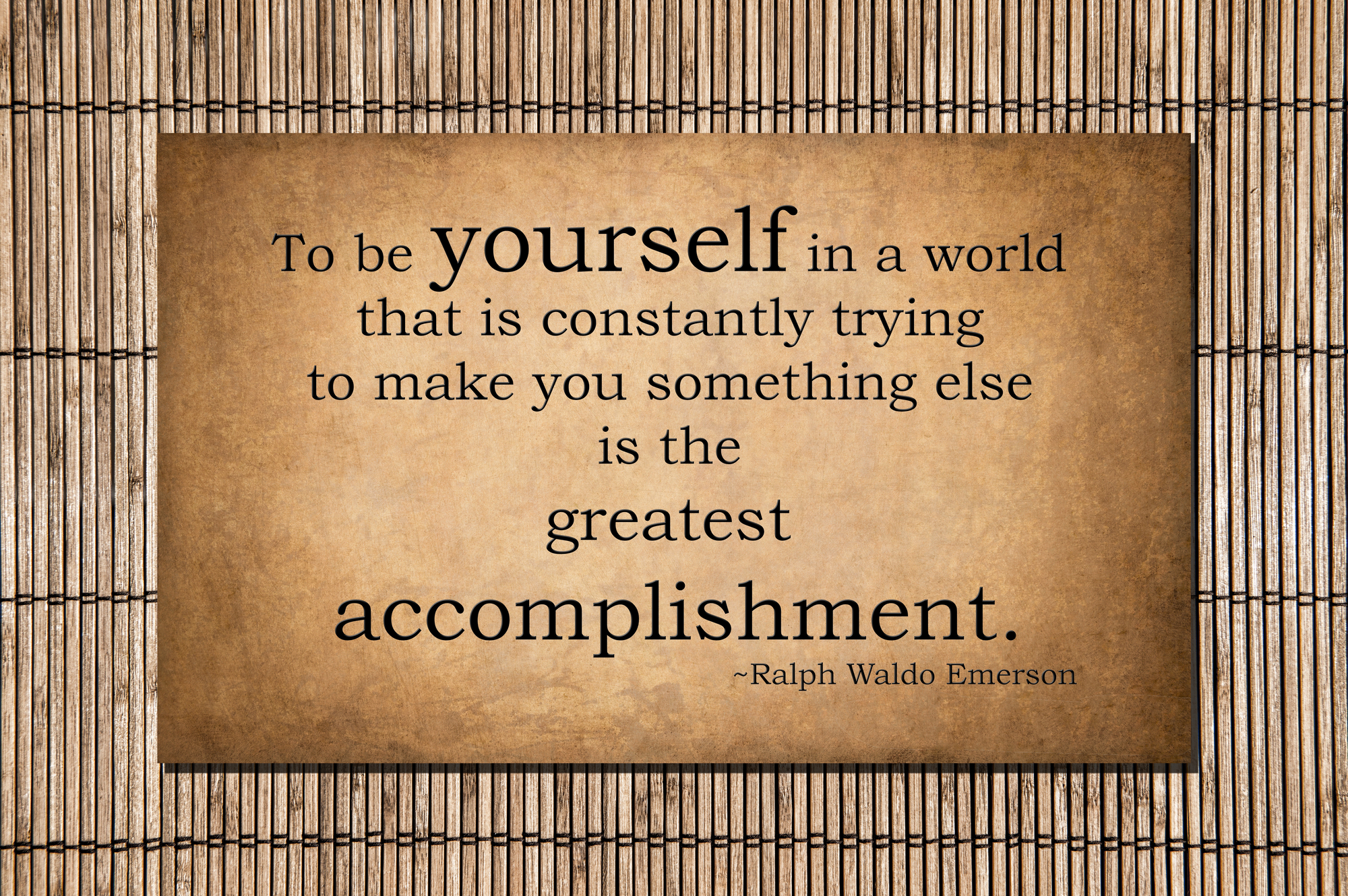
Quote: To be yourself in a world that is constantly trying to make you something else is the greatest accomplishment. - Ralph Waldo Emerson
I have taken the CliftonStrengths assessment twice. On a couple of other occasions, I've sat down, listed the things I've done successfully over my life, and looked for what they had in common. So I have a pretty good picture of my strengths and the conditions where I do my best work.
And I still routinely ignore all of it.
Instead, I'll come across a plan or a system that sounds like what successful people are supposed to do, and off I go, following it as if I'd never learned a single thing about myself. It's a strange habit when you think about it. We put real effort into understanding who we are, and then we turn around and try to succeed like somebody else.
I brought this up in a recent episode of my podcast, Yes, And with Avish Parashar, in a conversation with Ann Ranson. Ann is a coach, consultant, and facilitator who works at the intersection of purpose and performance, and a big part of her work involves helping people understand their strengths. So I asked her the question I've been wrestling with for years: once you know this stuff, how do you actually live it? (You can listen to the full conversation here.)
My Running Problem
The clearest example in my life is exercise. About every three to five years, I start running again.
And about four weeks later, I remember that I hate running.
This is not a knock on running. Running is great for people who enjoy running. Ann, it turns out, doesn't like running either. Her take was that the two of us would be sitting on a park bench together, watching everyone else jog by, which honestly sounds like a pretty good afternoon.
The issue isn't running itself. It's why I keep choosing it. I don't take up running because it fits me. I take it up because it's what fit, disciplined people seem to do. Recently I did a 21-day workout program and actually finished it (a minor miracle). Then I kept going, started feeling some aches and pains, and within about a week the whole thing had quietly tapered off into me feeling sorry for myself.
Part of what's going on, I think, is that I've absorbed our culture's admiration for one very specific kind of discipline: the Olympian who grinds every single day for two years straight. Somewhere in my head is a voice saying, "If you were really committed, you'd work out hard every day for 30 minutes to an hour." So instead of building around how I actually work, I keep trying to live up to someone else's ideal and then feel bad when it doesn't stick.
What I actually know about myself is that I tend to go all in on something for a stretch and then lose steam. Ann described a similar tendency in herself. She likes starting things more than finishing them. Rather than judging herself for it, she plans around it. If she's working on one area of her life, she'll focus on it for a month and then pick a different area the next month, because variety matters to her. For me, the equivalent might be planning workouts in intense, month-long blocks and deliberately shifting after that, instead of pretending I'm about to become a different person who loves the same routine forever.
The goal is still to get in shape, and that still takes effort. I'm just looking for a version of the effort I'll actually keep doing.
Same Job, Opposite Strengths
Then we started talking about the speaking business…
Ann's top strength is empathy. She feels what's going on around her, deeply, and as she put it, that means the good, the bad, and the ugly. She told me about a speaker showcase she took part in, where she bought a slot so she could get some video. By her own account, she had never been worse. She didn't know her name and couldn't get three words out.
Rather than just writing it off, she went home and reflected on what the experience was trying to teach her. Her conclusion was that she thrives in small groups. In a small room, she can sense when people are getting restless and adjust on the spot, maybe by switching to an activity. In front of a big audience, she doesn't get that same feedback, so the thing that makes her great at what she does doesn't have anywhere to go.
As she described this, I realized my experience is almost exactly the opposite. I've been performing since high school, and my energy comes most from big audiences. A keynote puts a little bit of distance between me and the crowd, and I like that. In a room of a thousand people, a few faces that aren't into it don't matter much, because I'm feeling the energy of the whole room. Put me in a small group, though, and if one person seems disengaged, all my attention goes straight to that person while the voice in my head announces, "I'm doing terribly."
Neither of us is the better communicator. We're both good at what we do; we just do it best under very different conditions. If Ann tried to get better at keynotes by copying my approach, or I tried to become a better facilitator by copying hers, we'd both be working against ourselves.
That doesn't mean you only do the things that come naturally. Ann was clear that if your boss needs something done, "that's not one of my strengths" isn't an acceptable answer. It may just be harder for you than for someone else. This is personal for me right now, because I've started taking on more consulting work, which means more small rooms. I'm not going to avoid it because it isn't a keynote. The question I'm asking is how I bring what I'm good at into a setting that doesn't naturally suit me.
What This Means for Leaders
Now scale this up to a team. A lot of organizations expect everyone to succeed the same way: The same process, the same working style, the same path to getting on board with a new initiative. Ann described a familiar version of this. Someone starts a new job, HR has them take an assessment, the results reveal a weakness, and off they go to a class to fix it. Her point was that you'll never be as good at something you don't have a strength in as the person who does, and you'll probably be frustrated and less productive trying.
In practice, these differences can show up in all kinds of ways. Some people do their best thinking in a lively group discussion, while others need time on their own to reflect first. Some people jump on a new initiative right away, and others need a different on-ramp before they're ready. None of these is wrong. But when a manager's own preferences quietly become the standard, a lot of people end up "running" when they'd be far more effective doing something else.
This matters most during change. An organization may genuinely need everyone to adopt the new system, follow the new process, or hit the same target. That's fair, and shared standards and accountability aren't the problem here. But needing everyone to reach the same outcome doesn't mean everyone needs the same route, the same support, or the same kind of motivation to get there.
Where Improv Comes In
This is one of the reasons I love improv. There's no script, no director, and no second take. You can't succeed in an improv scene by performing the way someone else would; you have to respond to what's actually happening, using whatever you bring to the moment. When it's done well, the most authentic version of you is what shows up.
Two parts of my YES AND Framework fit here. The Y is Yield to What Is, Let Go of What Was, Build Towards What Can Be. Part of "what is" is the reality of who you are: your strengths, your tendencies, and the things you will never enjoy (hello, running).
The E is Explore and Express Your Core, which is about understanding what makes you effective and finding ways to bring more of it into your work. Sometimes success requires adding new skills. Often, though, it comes from making better use of what's already there.
A Few Questions to Try
Here's what I've been asking myself, and what I'd invite you to think about:
- What conditions consistently bring out your best work?
- Where are you following an approach mainly because someone else says it's the right way?
- How could you adapt that approach to use more of your natural strengths while still getting the result you need?
And if you lead a team, one more: Where might you be asking people to follow your preferred approach when you could be helping them find their most effective one?
None of this is an argument against discipline or structure. I still need to exercise, and your team still needs to hit its goals. It's an argument for not confusing someone else's formula with the only formula there is.
P.S. If your organization is asking people to adapt to change and you're seeing them get stuck, it may be that they're being asked to succeed in a way that just doesn't fit them. My interactive keynotes and workshops help teams move past rigid "Yes, But" thinking and find more creative, adaptable ways to get where they need to go. If that sounds useful for your group, let's talk.
P.P.S. Ann and I covered a lot more in our conversation, including how our definitions of success should change as our lives do. You can listen to the full episode here.